Wi-Fi Sensing and the Future of Healthcare
If you have ever set up a smart home device or complained about a dead zone in your living room, you know how crucial Wi-Fi is to modern life. But beyond streaming high-definition video or connecting your smart thermostat, your humble Wi-Fi router is quietly developing a surprising new capability: it can act as a highly sensitive, contactless health monitor.
No smartwatches. No chest straps. No intrusive cameras recording you while you sleep. By reading the tiny disruptions in the wireless signals already blanketing your home, researchers can measure your breathing rate, detect sleep apnea, and spot falls from across the room.
The Magic of Channel State Information (CSI)
To understand how your router knows you are breathing, we have to talk about a fundamental networking concept called Channel State Information (CSI). When a Wi-Fi router talks to a client device—like your smartphone or a smart speaker—the radio frequency (RF) signal doesn’t just travel in a straight line. It bounces off walls, furniture, pets, and people, creating a chaotic web of multi-path reflections.
Usually, this multi-path environment is a headache for network engineers trying to optimize download speeds. However, modern Wi-Fi receivers use CSI to constantly estimate and map these reflections to maintain a strong internet connection. Because the human body is mostly made of water, we are highly reflective to these RF signals. Every time you move, or even take a breath, the physical space changes slightly. Your chest expanding by just a few millimeters alters the distance the signal travels to bounce back, causing the CSI values to shift minutely in phase and amplitude.
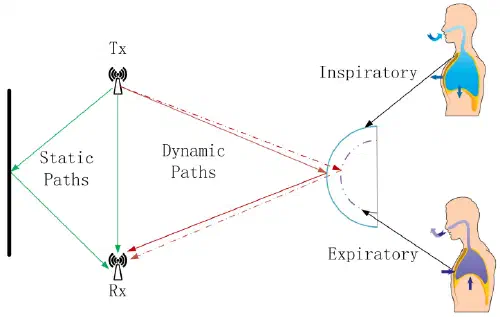
Recent large-scale research into continuous daily activity demonstrates that these shifts aren’t just random networking noise. When processed correctly, the variations map directly to human physical movements. Imagine your Wi-Fi signal acting as a microscopic sonar system, pinging everything in the room thousands of times a second.
Spotting the Unseen: From Breathing to Sleep Apnea
The level of biometric detail extractable from CSI is honestly staggering. According to a recent study on breathing monitoring via CSI ratio trajectories, algorithms can track the micro-movements of your chest rising and falling even in a busy environment. The researchers developed a clever method to map these changes on an I/Q (In-phase and Quadrature) complex plane. By tracking the trajectory of the signal across this plane, they successfully filtered out bigger, irrelevant movements (like rolling over in bed or adjusting a blanket) to hone in specifically on the steady rhythm of human respiration.
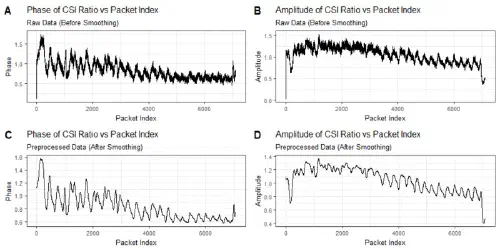
But this goes well beyond simply counting breaths per minute. Engineers are combining this raw wireless sensing data with attention-based machine learning to identify complex medical conditions like sleep apnea and Periodic Limb Movement Disorder (PLMD). Normally, detecting these disorders requires a patient to sleep in a specialized clinical lab while covered in electrodes—an experience that is uncomfortable, expensive, and artificial. Using off-the-shelf commercial Wi-Fi hardware, we can now monitor these sleep conditions continuously and unobtrusively in a patient’s own bed.
Enter IEEE 802.11bf: The Wi-Fi Sensing Standard
While hackers and academic researchers have been piecing together CSI data for a few years using custom Linux firmware, the wider networking industry has firmly taken notice. The Institute of Electrical and Electronics Engineers (IEEE) is officially standardizing these sensing capabilities under the upcoming IEEE 802.11bf amendment.
Designed to formally turn Wi-Fi networks into sensor networks, the 802.11bf standard defines a unified framework for WLAN (Wireless Local Area Network) sensing. It spans standard frequency bands like 2.4, 5, and 6 GHz, as well as the 60 GHz millimeter-wave spectrum. This means that soon, the hardware and software required to use Wi-Fi as a radar system will be baked directly into commercial devices right from the factory. You won’t need an advanced degree to flash your router to monitor an elderly parent for falls or secure your home—the capability will be an official, interoperable feature of the standard Wi-Fi ecosystem.
A New Era of Ambient Computing (and Privacy)
The implications of standardized Wi-Fi sensing are massive for eldercare, smart homes, and telemedicine. A smart home could detect if a resident has fallen in the kitchen and automatically call for help, even if there are solid walls between the person and the router. It could turn down the lights when it senses you’ve fallen asleep or instantly alert a parent if an infant’s breathing rhythm becomes irregular.
Of course, a system that can “see” through walls and monitor heartbeats immediately raises valid privacy flags. The data required for this level of sensing is deeply intimate. Fortunately, unlike optical security cameras, CSI relies entirely on physical RF wave disruptions. The system does not capture what you look like, what you are wearing, or the visual details of your physical space; it merely detects the kinetic disruption you represent. Furthermore, local edge-computing solutions could process this data directly on the router itself, ensuring that your raw physiological data never leaves your home network for a remote server.
The jump from a basic wireless internet conduit to an intelligent, ambient environment sensor is a massive technological leap. As standards like IEEE 802.11bf hit the consumer market, your standard-issue Wi-Fi router is about to become the most advanced, invisible health monitor you never knew you had.
References
- https://www.ncbi.nlm.nih.gov/pmc/articles/PMC12788229/