Why Old Beans Refuse to Soften
You soak a batch of dried beans overnight, simmer them for hours, and still find a stubborn, slightly chalky center. It is tempting to blame the soaking time, the burner, or the recipe. Sometimes, however, the beans have developed a real storage defect known as hard-to-cook, or HTC.
HTC is not simply a case of beans being extra dry. During long storage—especially in warm, humid conditions—the chemistry holding their cells together changes. Water may enter the seed perfectly well, yet heat has trouble dismantling the structural “glue” inside it. That distinction explains why another six hours of soaking can accomplish surprisingly little.
Softening depends on the glue between cells
The edible interior of a bean is made of cotyledon cells packed with starch and protein. Between those cells is the middle lamella, a pectin-rich layer that acts rather like mortar between bricks. Cooking must weaken and dissolve enough of this pectin for the cells to separate, producing a tender, creamy texture.
Starch gelatinization and protein denaturation sound like the obvious drivers of softening, but they are not the slowest step. In a 2023 study of fresh and aged red kidney beans, starch gelatinization at 95°C was essentially complete after about 10 minutes and protein denaturation after roughly 60 minutes. Texture and pectin solubilization took much longer, particularly in aged beans, which approached their final texture only after about 270 minutes. Pectin solubilization had by far the strongest relationship with softness.
In other words, a bean can contain cooked starch and denatured protein while its cells remain locked together. The bottleneck is the cell-wall network.
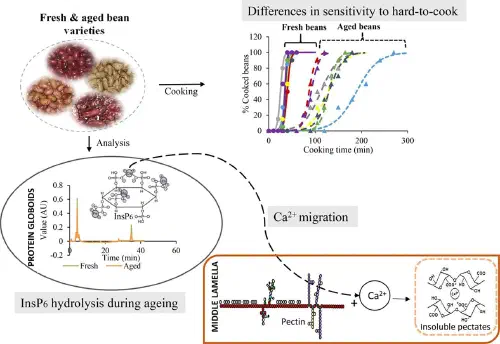
Source: Wainaina and colleagues’ study of the pectin–cation–phytate mechanism, Food Research International (2022), © Elsevier.
Phytate starts as a mineral locker
Dry beans naturally contain phytate, also called inositol hexaphosphate or IP6. Its strongly charged phosphate groups bind mineral ions, including calcium. That is nutritionally relevant—phytate and pectin both reduce mineral bioaccessibility—but the same mineral binding also matters to bean texture.
During storage, the bean’s own phytase enzymes gradually break IP6 into lower inositol phosphates. These products hold calcium less strongly, leaving more Ca²⁺ available to move. A storage-kinetics study found that IP6 hydrolysis accelerated strongly as storage temperature rose from 25°C to 42°C, and its rate closely tracked development of the HTC defect.
The freed calcium does not necessarily fasten itself to the cell wall immediately. A multi-variety investigation found that cell-wall-bound calcium rose mainly during the early stages of cooking, rather than substantially during dry storage or an ordinary soak. Heating appears to help the ions migrate toward pectin in the middle lamella.
Once there, Ca²⁺ can bridge negatively charged regions on neighboring pectin chains. This is often described with the “egg-box” model: calcium ions sit between aligned pectin molecules and link them into a more rigid network. The result is insoluble calcium pectate, which resists the thermal solubilization that normally lets bean cells pull apart.
Newer work also complicates one older part of the theory. The pectin’s degree of methylesterification does not always change much during hardening. The crucial event may therefore be less about manufacturing new calcium-binding sites and more about transporting calcium to binding sites that already exist. Bean variety matters too; researchers note that phenolic cross-linking and other mechanisms may contribute in some cultivars.
Why hard water and pH change the pot
The calcium inside an aged bean is only half the story. Cooking water can supply calcium from outside. In controlled hardening experiments, red kidney beans soaked and cooked in progressively stronger calcium-chloride solutions retained more hardness. Calcium entered the seed coat and cotyledons during soaking and cooking, reinforcing pectin without requiring phytate breakdown.
That gives hard water a plausible route to longer cooking times, particularly when beans are already old or HTC-prone. “Hard water” is not a mystical culinary variable: it contains elevated concentrations of divalent minerals, especially calcium and magnesium. Calcium is particularly effective at cross-linking pectin.
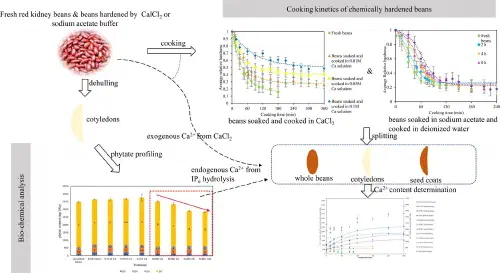
Source: Zhu and colleagues’ chemical-hardening experiments, Food Research International (2022), © Elsevier.
The water’s pH pushes the pectin network in the opposite or same direction. Research comparing soaking treatments found that low-pH and calcium solutions increased cooking time, while high-pH and monovalent-salt solutions reduced it. Mild alkalinity promotes pectin breakdown and solubilization; calcium-rich or acidic conditions tend to preserve the structural network.
This is also why ordinary sodium salt should not be confused with hard-water minerals. Sodium is monovalent and cannot bridge two pectin chains in the same way Ca²⁺ can. The blanket rule that “salt makes beans tough” misses the more important distinction between sodium salts and divalent calcium or magnesium salts.
Why a longer soak may not rescue old beans
Soaking is still useful. It hydrates the seed, evens out cooking, and often shortens the time needed for fresh, easy-to-cook beans. What it cannot reliably do is dismantle calcium-pectin cross-links that have developed because of storage chemistry.
The situation can even reverse under certain conditions. In the chemical-hardening study, longer exposure to a mildly acidic sodium-acetate buffer promoted IP6 hydrolysis, released endogenous calcium, and delayed subsequent softening. That does not mean a normal overnight soak is harmful. It means soak duration is only one variable, and not always the controlling one.
For a stubborn batch, practical interventions follow directly from the mechanism: use beans from a high-turnover supplier; store them cool and dry; try low-mineral water if the local supply is hard; and delay tomatoes, wine, vinegar, or lemon until the beans are tender. A small amount of baking soda can greatly accelerate softening by raising pH, although too much can produce damaged skins, an overly soft texture, or an alkaline taste. Pressure cooking adds temperature and can save time, but it cannot make severely aged beans behave exactly like a fresh crop.
The useful mental model is simple: soaking fills the bean with water, while cooking must dissolve the pectin mortar. If storage, calcium, and pH have converted that mortar into a more insoluble network, the problem is no longer just how long the beans sat in a bowl. It is materials science happening in a saucepan.
Further references
- https://pubmed.ncbi.nlm.nih.gov/33337000/
- https://www.sciencedirect.com/science/article/pii/S0308814623003606
- https://pubmed.ncbi.nlm.nih.gov/35651071/