Why Clean Laundry Smells: The Washer Biofilm Problem
You pull a load out of the machine, and something is off. The clothes are technically clean, but there’s a faint musty, damp-towel funk that no amount of fabric softener quite covers. Lean in toward the machine itself and you might catch it there too, hanging around the rubber door seal. It’s tempting to blame a bad rinse. The more accurate answer is ecology: your washing machine is a living habitat, and over time it can hand its own microbes off to everything you wash.
A wave of recent microbiome research has reframed that “clean smell that isn’t” as a microbiology problem rather than a housekeeping one. And the twist is that the well-intentioned way most of us do laundry today is exactly what lets the problem build.
The eco-friendly trade-off
Modern laundry has quietly gone green. To save energy and water, we wash cooler (often 30–40 °C), run shorter cycles, and reach for liquid, bleach-free detergents. That’s genuinely good for your power bill and the planet. The catch is that heat and oxidising bleach are the two things that reliably kill microbes and rupture their cell membranes. Take them away and you get cleaning without disinfection.
Researchers studying the bacterial community of domestic washing machines point out that low-temperature, bleach-free washing lets microorganisms survive the cycle and settle in. A separate study on hydrogen peroxide in low-temperature laundry makes the same point bluntly: because liquid detergents skip the bleach activators that powders sometimes carry, the result can be hygienically unsafe textiles and a machine interior that grows biofilm and starts to smell.
Your washing machine has a microbiome
A washer is close to a perfect microbial resort: warm, damp, full of leftover nutrients from detergent and body soil, and rarely allowed to dry out completely. The usual hotspots are the rubber door seal, the detergent drawer, and the sump at the bottom. Each niche selects for slightly different residents, so the drawer community looks different from the door-seal community.
Across studies the same cast keeps showing up: Gram-negative genera like Pseudomonas, Acinetobacter, and Moraxella (which older sequencing often mislabels as Enhydrobacter), alongside Micrococcus, Sphingomonas, and Staphylococcus, plus molds such as Aspergillus, Cladosporium, and Penicillium. Many of these organisms arrive from tap water, skin, and soil, then stay by building biofilms — slimy, matrix-encased communities that shrug off detergent, mechanical scrubbing, and drying far better than free-floating cells do.
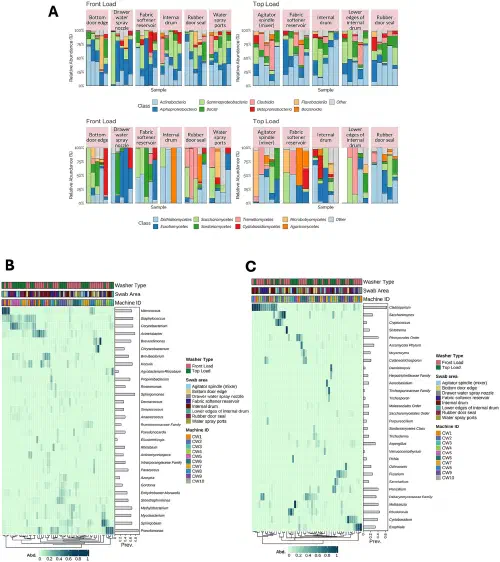
The 2025 survey of microbial cross-contamination in household laundering adds two useful details. First, front-loading machines carried noticeably higher microbial loads than top-loaders, probably because they hold residual water in the drum rather than draining fully. Second, the single biggest predictor of what lived in a machine wasn’t the machine’s brand or which surface was swabbed — it was the person using it. Each household essentially cultivates its own signature washer flora.
The plot twist: the machine colonizes your clothes
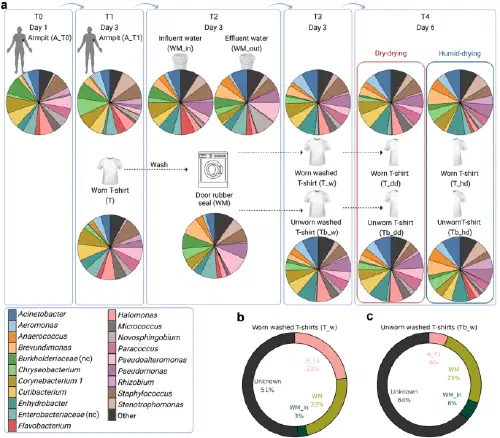
Here’s the finding that flips the usual mental model. You’d assume washing lowers the number of live microbes on your clothes. In the 2025 study on laundry malodour, the microbiome, and the pathogenome, it did the opposite. Using viability staining, the researchers found that the count of membrane-intact (living) bacteria on synthetic T-shirts actually rose after a standard 30 °C wash.
What changed was who was present. The Gram-positive skin commensals you carried in — the ones adapted to human skin — were largely displaced by Gram-negative, environment-associated bacteria. Where did the newcomers come from? Microbial source tracking pointed straight at the appliance: on washed shirts, roughly a quarter of the traceable bacteria came from the washing machine itself, with a smaller share from the incoming water. This echoes the foundational 2015 work on bacterial exchange in household washing machines, which first showed that a wash cycle blends microbes from the laundry, the machine, and the water into a shared community.
Biofilms, “permastink,” and why the funk comes back
Displacing your skin bugs with waterborne ones would be a curiosity if it stopped there. It doesn’t. The same study found that washing and, especially, drying clothes in humid conditions increased the abundance of genes tied to biofilm formation, adhesion, and motility. In other words, the community arriving from the machine isn’t just different — it’s genetically better equipped to glue itself to fabric and persist.
Over many wear-wash-dry cycles, that persistence is thought to feed “permastink,” the permanent musty odour that survives washing and clings to gym shirts and towels. The smell chemistry is well characterised: bacteria like Moraxella osloensis are primarily responsible for laundry malodour because they tolerate drying and convert sweat residues into pungent short-chain acids. A 2024 review of washing-machine colonisation, biofilm, and malodour ties the thread together: as detergents got gentler and greener, biofilms on machine surfaces got a firmer foothold, and the odour problem grew alongside them.
Should you actually worry?
For most healthy people, this is a nuisance, not a health scare. The organisms involved are mostly opportunists — capable of causing infection under the right conditions, but not aggressive pathogens for someone with an intact immune system. The cross-contamination survey specifically found no high-risk pathogens in its sampled machines.
Two caveats keep it from being purely cosmetic. First, the malodour study documented a rising “pathogenome” signal after washing: more virulence-factor and antibiotic-resistance genes on laundered clothes, including a multidrug-efflux pump associated with Gram-negative bacteria and biofilms. Second, washers can occasionally move genuinely worrying microbes. In one documented case, a home machine transmitted an antibiotic-resistant Klebsiella strain to newborns in a hospital setting. So for households with immunocompromised members, infants, or anyone sick, extra care is reasonable.
What actually helps
The fixes follow directly from the biology. Give the machine the occasional hot treatment: a periodic maintenance wash at 60 °C or higher (empty or with towels) restores the heat that low-temp cycles remove. Add oxidising power when hygiene matters — the hydrogen peroxide study found that 3% peroxide dosed into the main wash disinfected effectively at 40 °C without fading colours or weakening fabric, and oxygen-bleach (“activated oxygen”) detergents work on the same principle. Then attack the habitat itself: wipe down and dry the rubber seal and detergent drawer, and leave the door ajar between loads so the drum can dry, since standing moisture is what biofilms depend on. The cross-contamination team reached the same practical conclusion — detergent alone isn’t enough, so supplemental sanitising and interior cleaning are what keep both odour and microbial load down.
None of this means abandoning cool, efficient washing. It means recognising that a modern eco-cycle is a compromise, and spending a little heat, oxygen, or airflow now and then to keep your washer’s private microbiome from becoming your wardrobe’s.
References
- https://pmc.ncbi.nlm.nih.gov/articles/PMC5797641/
- https://doi.org/10.1080/08927014.2010.524297
- https://doi.org/10.3390/microorganisms12010160
- https://doi.org/10.1128/AEM.03002-20
- https://doi.org/10.15698/mic2019.07.682