Unlocking Iron and Zinc Through Fermentation
Fermentation Frees Minerals in Grains and Beans.
A bowl of maize porridge or chickpeas can contain plenty of iron and zinc on paper, yet deliver less of those minerals than the nutrition label suggests. The main obstacle is phytate, or phytic acid: the phosphorus-storage molecule that plants pack into seeds. Its phosphate groups readily bind positively charged minerals, forming complexes that are harder to dissolve and absorb during digestion.
That does not make phytate a poison, nor does it mean every mineral in a bean is trapped. The effect depends on the amount of phytate, the mineral, the rest of the meal, and a person’s overall diet. It matters most when unrefined cereals and legumes provide a large share of daily calories and there are few alternative sources of easily absorbed iron or zinc.
Fermentation changes the food matrix
Lactic-acid fermentation attacks the problem indirectly. Lactic acid bacteria consume available carbohydrates and lower the food’s pH. That acidic environment can activate phytase already present in the grain or bean, while some microbes contribute phytase of their own. Phytase removes phosphate groups from phytate step by step, producing smaller inositol phosphates that generally hold minerals less tightly.
This is why fermentation can do more than preserve food or make it pleasantly sour. A broad review of fermentation and germination in cereals and legumes describes a linked set of changes: acids accumulate, seed enzymes wake up, microbial enzymes join in, and the surrounding protein-and-starch matrix becomes easier for digestive enzymes to reach.
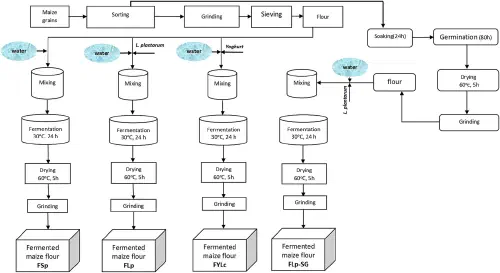
Processing routes used to produce fermented maize flour. Source: Nsabimana, Ismail and Lazarte, Frontiers in Nutrition (2024), CC BY 4.0.
Stacking soaking, sprouting, and fermentation
A 2024 maize study comparing several household-scale processes shows how strongly the steps can reinforce one another. Starting from about 9.58 grams of phytate per kilogram of dry maize, spontaneous fermentation removed 51.8%. Fermentation with Lactiplantibacillus plantarum removed 65.3%, while a yogurt culture removed 68.7%.
The largest change came from stacking methods. Researchers soaked the kernels for 24 hours, germinated them for 80 hours, milled them, and then fermented the flour with L. plantarum. Phytate fell by 85.6%, to about 1.39 grams per kilogram. Soaking hydrates the seed and can wash out some soluble compounds; germination activates the seed’s own enzymes; fermentation then supplies acidification and microbial metabolism.
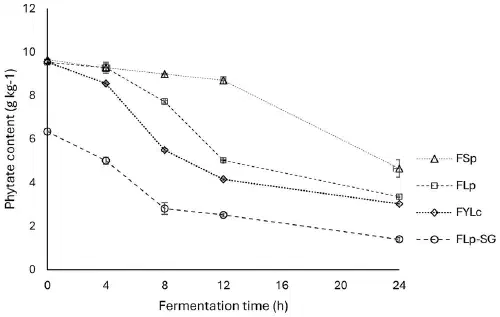
Phytate decline during four maize fermentation treatments. Source: Nsabimana, Ismail and Lazarte, Frontiers in Nutrition (2024), CC BY 4.0.
The study estimated mineral availability with phytate-to-mineral molar ratios. The phytate-to-zinc ratio dropped from 40.76 in raw maize to 7.77 after the combined treatment, below the study’s threshold of 15 for substantially reduced zinc inhibition. The phytate-to-iron ratio fell from 41.42 to 6.24, a major improvement but still above the study’s preferred value below 1. In other words, the same processing chain appeared to unlock zinc more completely than iron.
There was also a trade-off. Zinc concentration itself fell by about 16% in the combined treatment, probably because some zinc escaped into discarded soaking water. Processing can therefore improve the fraction that is accessible while losing part of the original mineral. Measuring phytate alone misses that balance.
Beans do not all respond the same way
The maize result is impressive, but it is not a universal fermentation constant. In a 2025 study of chickpea flour fermented with 14 lactic-acid-bacteria strains, most cultures brought the puree below pH 5 within 48 hours. Only some strains significantly lowered phytic acid, and the reduction was roughly 10–15%. Several of those cultures produced much larger changes in antioxidant capacity, polyphenols, peptides, and free amino groups than in phytate.
Faba bean gives an even sharper comparison. A bioprocessing experiment with faba-bean flour found that 24 hours of Lactobacillus plantarum fermentation lowered phytic acid only modestly, from about 9.7 to 8.8 milligrams per gram. Adding a purified phytase treatment under optimized conditions degraded as much as 89% and improved protein solubility and in-vitro digestion.
The lesson is not that fermentation “works” for maize and “fails” for beans. It is that the useful enzyme activity depends on the crop, its native phytase, particle size, temperature, pH curve, fermentation time, and microbial strain. A culture selected for flavor or rapid acid production may not be a strong phytate degrader.
Estimated bioavailability is not absorption
Most food-processing experiments do not feed isotope-labelled meals to volunteers. They estimate bioavailability from phytate-to-mineral ratios, soluble mineral measurements, or simulated digestion. These are useful screening tools, but the human intestine sees a complete meal rather than an isolated flour.
Human evidence supports the basic mechanism while also showing the complications. In a controlled study of cereal porridges, degrading phytate improved iron absorption from porridges made with water, but the benefit changed when milk or high-tannin sorghum entered the meal. Tannins and other polyphenols can also bind iron; fermentation may reduce some of them, while germination or microbial enzymes can release other phenolics from the food matrix. Vitamin C, calcium, proteins, and the body’s current iron status further alter the final result.
That is why “85% less phytate” should be read as a strong processing result, not a promise of 85% more absorbed iron. The most convincing studies combine phytate measurements with mineral retention, simulated digestion, and ultimately human absorption data.
What this means in the kitchen
Traditional sourdoughs, fermented porridges, cereal batters, and legume pastes already use parts of this chemistry. The research suggests that longer acidification, an active starter, and pre-germination can outperform a brief soak alone. It also suggests that copying the timing from one grain to another is unreliable.
For home preparation, established recipes and food-safe starter practices matter more than maximizing fermentation time. Discarding soak water may remove some phytate but can also remove minerals and water-soluble vitamins. Germination adds another enzyme-rich stage, but it requires careful hygiene. Fermentation is best understood as a tunable process that can improve mineral access, flavor, digestibility, and preservation at once—not as a single switch that turns an “antinutrient” off.
The broader point is simple: nutrient content and nutrient delivery are different things. By combining soaking, sprouting, and the right fermentation culture, it is sometimes possible to make the iron and zinc already present in grains and beans more available without adding anything new.
Further reading
- https://pubmed.ncbi.nlm.nih.gov/17374686/
- https://academic.oup.com/nutritionreviews/article/76/11/793/5053734
- https://pmc.ncbi.nlm.nih.gov/articles/PMC3189212/
- https://link.springer.com/article/10.1186/s43014-020-0020-5
- https://www.mdpi.com/2311-5637/8/2/63