The Yeast Behind Fruitier, Floral Coffee
Your Coffee’s Flavor Might Be Decided by a Microbe You’ve Never Met
Long before a coffee bean ever hits a roaster, it goes through a wet, messy, microbial process that almost no one drinking the cup ever thinks about. Freshly picked coffee cherries are wrapped in a sticky, sugary layer called mucilage, and to get clean green beans out, processors let microbes eat that layer away. This is coffee fermentation, and for most of history it has been a spontaneous free-for-all: whatever yeasts and bacteria happen to be drifting around the farm show up and do the work.
That randomness is a problem if you care about consistency. One batch comes out tasting like ripe stone fruit and jasmine; the next tastes flat, vinegary, or just muddled. The idea gaining momentum in coffee science is to stop leaving it to chance and instead deliberately inoculate the beans (or the whole cherries) with specific, hand-picked yeast strains — the same way a brewery pitches a known yeast instead of hoping the right wild ones float into the tank.
Why these particular yeasts
The stars of this research are “non-Saccharomyces” yeasts, which is just a way of saying they aren’t the everyday bread-and-beer species Saccharomyces cerevisiae. Two names come up again and again: Pichia kluyveri and Torulaspora delbrueckii. Both are borrowed from the wine world, where they’re valued for pumping out aromatic esters — the family of molecules responsible for fruity and floral smells.
P. kluyveri is especially good at making esters while producing very little alcohol, which is exactly what you want when the goal is aroma rather than booze. In a 2020 study on green coffee beans, researchers fermented sterilized beans with single yeast species and watched fruity esters build up directly inside the bean. One of them, 2-phenylethyl acetate (imagine rose petals and honey), jumped noticeably in the P. kluyveri batch. The same work showed S. cerevisiae leaned more toward nutty and roasted notes, hinting that you could pick a strain the way you pick a paint color.
The roasting problem
Here’s the catch that makes coffee trickier than wine: after fermentation, the beans get roasted at temperatures north of 200 °C. Plenty of delicate aroma compounds simply don’t survive that inferno. So the real question isn’t “can yeast make a green bean smell nice.” It’s “does any of that nice smell actually make it into your cup?”
The encouraging answer is: partly yes, and through two separate routes.
The first route is direct survival. A follow-up study using mixed yeast cultures found that co-culturing S. cerevisiae with P. kluyveri boosted the ester isoamyl acetate (that classic banana note), and that this ester partially made it through roasting to give the finished coffee a fruity, wine-like character. Not everything survives, but enough does to shift the flavor.
The second route is sneakier and arguably more important. The yeasts change the bean’s underlying chemistry in ways that only pay off later, in the roaster. By fermenting sugars into organic acids like lactic and acetic acid, they lower the bean’s pH. A more acidic bean then produces more of the nutty, caramel, and toasty molecules — pyrazines and furans — that form during the Maillard reaction while roasting. In other words, the yeast isn’t only adding flavor of its own; it’s quietly rigging the roast to build extra flavor on top.
Taking over the tank
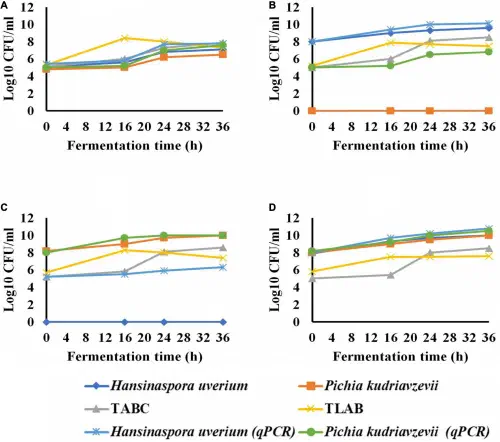
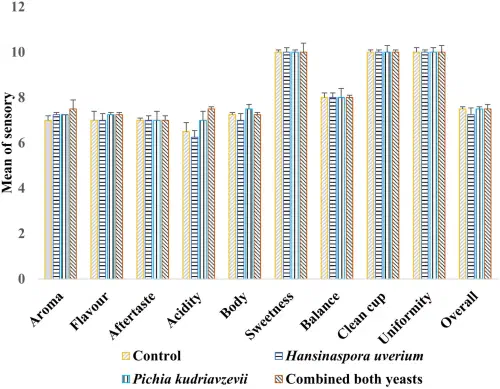
For a designer yeast to be useful, it can’t just be present — it has to dominate, outcompeting the random wild microbes that would otherwise steer the batch. An Australian experiment tested this by inoculating wet coffee fermentations with two yeasts and tracking who won. The added strains grew to populations roughly a hundred times larger than the yeasts in the spontaneous control, chewed through the mucilage sugars faster, and produced two to three times more alcohols, esters, and acids in the green beans. When trained Q-grader tasters cupped the results, the inoculated coffees scored higher on flavor, aroma, and acidity, and the panel described distinct notes like almond, apple cider, and walnut depending on which yeast had been used.
Matching the microbe to the bean
The newest wrinkle is that not every coffee wants the same yeast. Arabica and Conilon (a robusta variety) start with very different chemistry, so a strain that flatters one may do nothing for the other. A 2025 strain-selection study screened dozens of wild yeast isolates for their ability to break down mucilage and generate the right aromatic compounds, then sorted them by which coffee they suited. Some strains shone in Arabica; a P. kluyveri strain stood out for Conilon by boosting esters and organic acids. It’s the beginning of something like a strain catalog: pick your bean, pick your target flavor, pick your yeast.
The reality check
None of this is a guaranteed upgrade, and it’s worth staying skeptical of any “engineered flavor” hype. Results vary between farms, seasons, and strains, and at least one study found that a well-behaved P. kluyveri strain barely changed the final roasted profile once the beans were cupped — great for reliable processing, less dramatic for taste. Real fermentations also aren’t sterile lab jars; wild microbes still crash the party, and a starter that dominates in one climate can fade in another. Scaling a tidy experimental result up to a working wet mill, without special equipment or a lab on site, remains the hard part.
Still, the direction is clear. Coffee fermentation is shifting from a folk process you pray goes well into something closer to a recipe with dials you can turn. The next time a bag of specialty coffee brags about “controlled fermentation” and tastes improbably like tropical fruit, there’s a decent chance the credit belongs to a yeast that someone chose on purpose.
References
- https://ift.onlinelibrary.wiley.com/doi/10.1111/1750-3841.70431
- https://pmc.ncbi.nlm.nih.gov/articles/PMC11719620/
- https://pmc.ncbi.nlm.nih.gov/articles/PMC8332367/
- https://www.sciencedirect.com/science/article/abs/pii/S0963996923011808
- https://eurekamag.com/research/101/077/101077660.php