The Physics of Microwave Hot and Cold Spots
Why Your Microwave Cooks Lava Edges and an Icy Center.
We’ve all been there: you nuke last night’s leftovers, take a bite of a molten-hot edge, then hit a chunk that’s still fridge-cold in the middle. It feels like the microwave is trolling you. It isn’t. That patchy heating is baked into the physics of how a microwave oven works, and researchers are now using heavy-duty computer models to understand it and design their way out of it.
Standing waves: an invisible egg-carton of energy
A microwave oven is basically a metal box with a device called a magnetron firing electromagnetic waves into it, almost always at 2.45 gigahertz. Those waves don’t just travel straight to your food. They bounce off the metal walls, ceiling, and floor, then overlap with each other. Where two wave crests line up, they reinforce into a zone of high energy called an antinode. Where a crest meets a trough, they cancel out into a node with almost no energy. The result is a fixed, three-dimensional pattern of hot and cold pockets sitting in the air of your oven. As the review Toward Uniform Microwave Heating in Food Drying explains, these standing waves are the root cause of the hot-and-cold-spot problem, producing “hot spots” at antinodes and “cold spots” at nodes.
How closely spaced are these pockets? Inside the oven’s waveguide at 2.45 GHz, the effective wavelength is roughly 16 centimeters, and the nodes and antinodes repeat every half-wavelength, about 8 centimeters, according to the experiments in a 2025 Scientific Reports study. That’s smaller than a dinner plate, which is exactly why a single serving can span several hot and cold zones at once.
Water, salt, and the shape of your dinner
Standing waves set up the pattern, but your food decides how dramatically it plays out. Microwaves heat mostly by grabbing water molecules and flipping them back and forth about 2.45 billion times a second; that molecular jostling creates friction, and friction is heat. Salt adds a second mechanism, since dissolved ions get pushed around by the field too. So a salty, watery food soaks up energy fast, while a dry or fatty one lags behind.
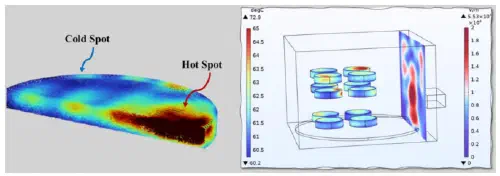
Shape matters just as much. Round and cylindrical foods tend to heat evenly, while irregular chunks and sharp corners overheat thanks to what engineers call the “edge effect.” There’s also a nasty feedback loop: as some foods warm up, their ability to absorb microwaves changes, so hot spots can run away and get even hotter. This is why packaged ready-to-eat meals are notorious for a scorched rim and a cool core, a pattern studied in detail using a technique we’ll meet next.
Simulating the mess with FDTD and machine learning
You can’t easily stick a thermometer inside a moving field of microwaves, so scientists build virtual ovens instead. The workhorse method is called finite-difference time-domain (FDTD), which chops the oven cavity into a grid and calculates how the electric field evolves step by step. Researchers used exactly this approach to build a “digital twin” of an industrial sterilizer and map how the field cooks a model meal, described in this FDTD study of ready-to-eat meals.
FDTD is powerful but slow, so the newest frontier layers machine learning on top of it. A review of mechanistic and machine-learning modeling of domestic ovens lays out how these data-driven models can predict heating patterns and optimize settings far faster than brute-force simulation alone, without running a full physics solve every time.
Turntables, stirrers, and their limits
The oldest fix is the humble turntable. By slowly dragging your food through the fixed field, it averages out the exposure so no single spot camps in a cold node the whole time. That’s genuinely useful, improving uniformity by roughly 37 to 43 percent in tests, and some ovens instead use a hidden “mode stirrer,” a rotating metal fan that scatters the incoming waves. But neither trick erases cold spots. In one simulation of packaged sausages, the gap between the hottest and coldest points reached a startling 55 degrees Celsius in a stationary oven, as reported in a study comparing stationary and rotating ovens.
The clever new trick: spin the field, not the food
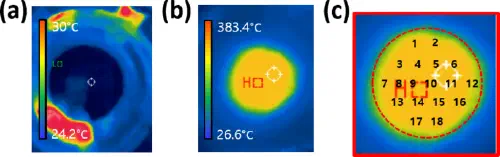
Here’s the idea researchers are excited about: instead of physically moving your dinner, why not make the energy pattern itself rotate? In the Scientific Reports paper on a rotating electric field, a team placed four waveguides at the corners of the cavity and shifted the timing (the phase) of two of them by a quarter wavelength. The overlapping waves then combine into an electric field that sweeps around in a circle, smearing the hot and cold zones evenly across the target with no moving parts at all. They also stretched the effective wavelength by tuning the waveguide height so the nodes spread far apart.
The payoff was striking. Heating a 4-inch silicon wafer for 20 seconds, they measured a coefficient of variation (a standard evenness score where lower is better) of just 0.05, with the field staying uniform across a 150-millimeter area, about 2.5 times wider than a conventional single-waveguide setup.
What it means for your leftovers
Most of this cutting-edge work targets factories and materials labs, not the box on your counter, which still relies on a magnetron and a turntable. But the direction of travel is clear: solid-state generators that fine-tune frequency and phase, multi-frequency “sweeping,” and smart sensor-driven control are all creeping toward consumer ovens. Until then, the physics gives you a cheat sheet. Stir halfway through so cold pockets rotate into hot ones, keep food in an even ring rather than a tall pile, cover it to trap steam, and let it rest a minute so heat can even out by plain old conduction. Your leftovers can’t beat standing waves, but they can outsmart them.
References
- https://www.mdpi.com/3042-5697/1/3/12
- https://pmc.ncbi.nlm.nih.gov/articles/PMC12854049/
- https://pmc.ncbi.nlm.nih.gov/articles/PMC10417755/
- https://www.researchgate.net/publication/392030005_Uniform_temperature_distribution_in_microwave_heating_achieved_via_rotating_electric_field