The Mustard Trick for Broccoli
Broccoli does not store much ready-made sulforaphane. Instead, it keeps two ingredients apart: glucoraphanin, a relatively stable precursor, and myrosinase, an enzyme that converts that precursor into sulforaphane when plant cells are damaged by chopping or chewing.
That arrangement works well in raw broccoli. It works less well after boiling, microwaving, or other sustained heating, because the enzyme is much easier to damage than the precursor. The useful twist is that the missing enzyme does not have to come from the broccoli itself. Mustard seed carries its own myrosinase, so a little dry mustard powder added after cooking can restart the reaction.
Heat breaks the enzyme, not the whole system
Think of glucoraphanin as stored material and myrosinase as the tool that opens it. Cooking can leave a fair amount of the stored material in place while disabling the tool. In a 2013 food-chemistry study, boiling prevented significant sulforaphane formation because broccoli myrosinase had been inactivated. Adding powdered mustard seed to the cooked broccoli restored the conversion.
A later broccoli and mustard study made the contrast unusually clear. Broccoli cooked at 100 °C for 12 minutes retained nearly as much glucoraphanin as raw broccoli, but contained very little sulforaphane. Adding 2% mustard seed powder after cooking raised measured sulforaphane from about 0.58 to 10.90 micromoles per gram of dry weight.
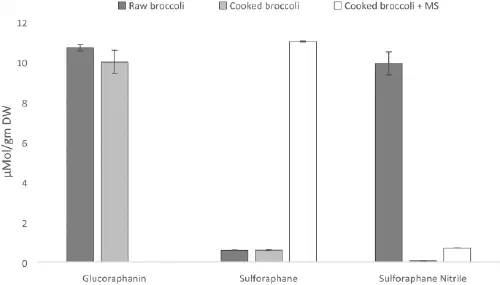
Cooked broccoli kept its glucoraphanin but made little sulforaphane until mustard seed powder supplied active myrosinase. Source: Abukhabta et al., licensed CC BY 4.0.
Mustard is useful here because its form of myrosinase is more heat-tolerant than broccoli’s. That does not make it indestructible. The safest kitchen approach is still to add mustard powder after the broccoli has been cooked, rather than roasting or boiling the powder along with it.
The effect also appears in people
Test-tube chemistry is one thing; absorption in humans is more useful. A 2018 randomized crossover trial gave 12 healthy adults 200 grams of cooked broccoli, either alone or with 1 gram of powdered brown mustard. Researchers collected urine for 24 hours and measured a major sulforaphane metabolite. The mustard treatment produced more than four times as much of that metabolite on average.
A separate study used broccoli soup and 11 participants with ileostomies, which allowed researchers to examine what reached the end of the small intestine. Mustard powder was mixed into the soup during cooling, at roughly 60 °C. It increased sulforaphane in the soup by nearly fourfold and increased the amount recovered in ileal fluid about sixfold, although the absolute amount reaching that point remained below 1% of what had been present in the soup.
The newest evidence comes from a 2026 randomized, double-blind crossover study. This was not a plate of cooked broccoli: participants swallowed a glucoraphanin-rich broccoli seed extract, with or without active myrosinase from mustard seed powder. Even so, it tested the same biochemical bottleneck. Adding mustard-derived myrosinase increased average 24-hour conversion to sulforaphane and its metabolites from 18.6% to 39.8%, and the difference was especially large during the first eight hours.
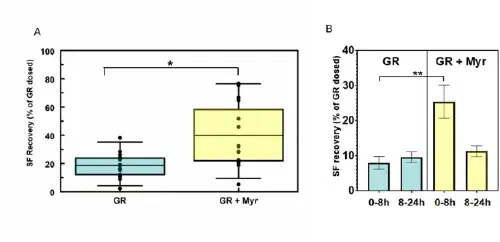
Mustard-derived myrosinase roughly doubled total 24-hour conversion and produced a larger early response. Source: Mastaloudis et al., licensed CC BY-NC-ND 4.0.
A practical kitchen version
The evidence-aligned method is simple:
- Cook the broccoli in whatever way makes you likely to eat it.
- Let it stop steaming aggressively.
- Add a light dusting of dry mustard powder or freshly ground raw mustard seed, then mix.
The human cooked-broccoli trial used 1 gram of brown mustard powder with 200 grams of broccoli. Calling that “a pinch” is convenient kitchen language, not a standardized scientific dose. More is not automatically better: mustard brings pungency, bitterness, and heat, and a sensory study found that many tasters disliked broccoli when the mustard character became obvious.
Dry mustard powder is a closer match to the experiments than prepared table mustard, whose enzyme activity may vary with manufacturing and storage. Other raw cruciferous foods—including radish, daikon, and some fresh mustard greens—can also provide myrosinase, but the amount delivered by a casual garnish is harder to predict.
There is another option when planning ahead: chop broccoli before cooking and give the plant’s own enzyme time to work. Brief steaming can also preserve more myrosinase than prolonged boiling. Mustard powder is most useful when the broccoli has already been thoroughly cooked or reheated and the native enzyme is likely gone.
What the mustard trick does not prove
These experiments show improved formation, conversion, or bioavailability of sulforaphane. They do not show that adding mustard to dinner prevents cancer, treats inflammation, or produces a specific long-term health outcome. The human trials were small and mostly examined what happened after a single meal or dose.
The studies also reveal substantial variation between people. Gut bacteria can perform some myrosinase-like conversion when plant enzyme is missing, but that fallback is slower and inconsistent. Supplying active enzyme with the food makes the chemistry less dependent on whichever microbes happen to be present.
The sensible conclusion is modest but useful: cooking may destroy broccoli’s conversion enzyme while leaving much of its precursor intact, and mustard seed powder can replace the missing enzyme. It is a rare food-science trick that is cheap, mechanically plausible, and supported by both controlled food experiments and small human trials.
Further references
- https://clinicaltrials.gov/study/NCT04946526
- https://pubmed.ncbi.nlm.nih.gov/22471240/
- https://centaur.reading.ac.uk/39483/
- https://journals.plos.org/plosone/article?id=10.1371%2Fjournal.pone.0140963