The Inverse Magnus Effect - Spinning Balls Go Weirdly
Every physics teacher’s favorite sports demo goes like this: put backspin on a ball, and it gets extra lift. Put sidespin on a football and it bends around the wall. This is the Magnus effect, described by Heinrich Gustav Magnus in 1852 and observed by Newton watching tennis players almost two centuries earlier. It’s reliable, intuitive, and drilled into every player who has ever shaped a shot.
Except sometimes it runs in reverse. Under a specific combination of speed and spin, a ball curves against its spin — a backspun ball dips instead of floating, a hooked golf shot breaks the wrong way. Fluid dynamicists call this the inverse (or reverse, or negative) Magnus effect, and it’s not a measurement glitch. It’s a real, repeatable phenomenon that lives in a narrow aerodynamic window, and it explains some of the strangest ball flight in sport.
A quick refresher on the normal Magnus effect
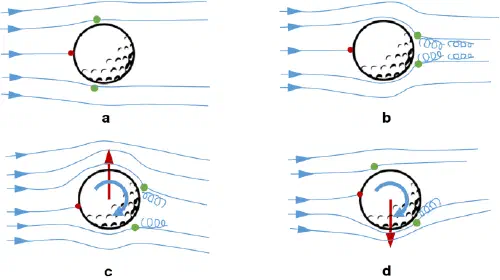
A spinning ball drags a thin layer of air — the boundary layer — around with its surface. On the retreating side (where the surface moves with the airflow), the flow stays attached to the ball a little longer before separating. On the advancing side (surface moving against the flow), separation happens earlier. The result is an asymmetric wake, deflected toward one side, and by Newton’s third law the ball gets pushed the other way. For backspin, the wake tilts down and the ball gets lift. So far, so textbook.
The catch is that this picture quietly assumes the boundary layer behaves the same way on both sides of the ball — either laminar on both, or turbulent on both. Near one particular speed range, that assumption breaks.
The mechanism: one side turbulent, one side laminar
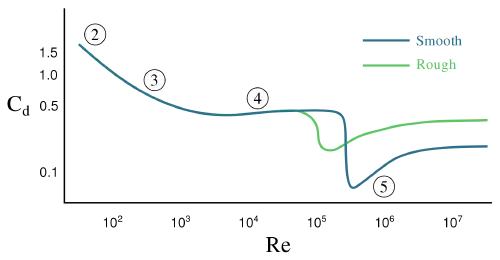
Around a Reynolds number of roughly 10⁵ — for a smooth ball the size of a football, that’s on the order of 20–30 m/s, exactly free-kick territory — a sphere passes through its drag crisis. This is the regime where the boundary layer transitions from laminar to turbulent, the separation point jumps rearward, and drag suddenly drops. Golf ball dimples exist precisely to trigger this transition at lower, golfer-achievable speeds.
Now add modest spin, with a spin ratio below about 1 (surface speed slower than flight speed). The advancing side of the ball sees a higher relative airspeed, so its boundary layer trips into turbulence first. The retreating side sees a lower relative speed and stays laminar. A turbulent boundary layer carries more momentum near the surface and clings to the ball much longer before separating — so suddenly the advancing side, not the retreating side, holds the flow furthest around the back of the ball.
The asymmetry flips, the wake deflects the opposite way, and so does the force. In their foundational 2014 study, Kim, Choi, Park and Yoo measured forces and flow fields on a rotating sphere with particle image velocimetry and showed exactly this: the turbulence “energizes” the advancing-side flow, delays its separation, and generates negative lift. They even derived empirical formulas predicting where the flow separates as a function of Reynolds number and spin ratio — effectively a map of when the effect switches on.
A narrow, twitchy window
The inverse Magnus effect only shows up when the ball sits right in the drag crisis with low spin — Reynolds numbers around 0.6–2 × 10⁵ and spin ratios well below 1 in the classic experiments. Speed up, slow down, or spin harder, and both boundary layers end up in the same state and the ordinary Magnus effect returns. That narrowness is why the effect went underexplored for so long, even though hints go back to Lafay in 1910 and Maccoll’s spinning-sphere experiments in 1928.
It’s also unstable. Wind-tunnel measurements show the lift force can flip back and forth intermittently under fixed conditions, a bistable tug-of-war between the two regimes. A ball flying through this window doesn’t just curve the wrong way — it can wobble between curving and not curving. If you’ve watched a low-spin “knuckling” free kick flutter unpredictably, or remember goalkeepers cursing the notoriously smooth Adidas Jabulani at the 2010 World Cup, you’ve seen what happens when a ball hangs around the drag-crisis regime. The Magnus effect explainer at Engineered Mind walks through why the Jabulani’s smoothness widened exactly this problematic zone — and why a perfectly smooth football would be unplayable.
It happens to real golf balls, too
You might expect dimples to immunize a golf ball, since they force turbulence everywhere. Not quite. Lyu, Kensrud and Smith fired three commercial golf ball models through still air and found all of them produced negative lift between Re ≈ 5–7 × 10⁴ and spin rates of 750–2250 rpm. Interestingly, the steeper a ball’s drag crisis, the stronger its reverse Magnus effect — hexagonal dimples fared worse than circular ones. These are slow, low-spin conditions by tour standards, but very reachable for a chipped shot or a range ball.
A companion study by Sakib and Smith used particle image velocimetry on golf balls and smooth balls launched through still air (rather than mounted in a wind tunnel) and confirmed the mechanism directly: the reverse regime exists while the retreating boundary layer is laminar and the advancing one turbulent, and it ends once the retreating side trips into turbulence too.
Still an active research topic
This is not a closed chapter. A 2025 study in the Journal of Fluid Mechanics by Milner and Scobie at the University of Bath found a laminar separation bubble and a secondary vortex coexisting on the advancing side during the inverse regime, and made the first experimental observation that the pair of wing-tip-like vortices trailing a spinning sphere actually reverses polarity when the force flips. The wake doesn’t just tilt the other way; its whole vortex structure inverts, like an airplane wing flipped upside down.
And it gets stranger. A 2023 experiment by Nagahiro and Hayakawa showed that dilute water fog — droplet concentrations so low they barely change the air’s density or viscosity — significantly lowers the Reynolds number and spin threshold at which the inverse effect kicks in. Oil and glycol smoke did nothing; only electrically charged water droplets triggered it. Japanese soft tennis players apparently knew this empirically all along: they have a word, fuku, for shots that break the wrong way in thick fog.
Why it matters beyond sport
Spinning spheres moving through fluids show up everywhere: sediment grains saltating in rivers, skipping stones, projectiles, particle-laden industrial flows, and Flettner rotors on fuel-saving cargo ships. Anywhere a designer relies on Magnus lift, the inverse regime is a lurking failure mode — and anywhere unpredictability is the enemy (or the weapon, if you’re taking the free kick), it pays to know exactly where the window sits.
The satisfying part is how ordinary the ingredients are. No exotic physics, just two boundary layers on the same ball refusing to agree on whether to be laminar or turbulent — and a force that points wherever their argument lands.
References
- https://snu.elsevierpure.com/en/publications/inverse-magnus-effect-on-a-rotating-sphere-when-and-why/
- https://www.researchgate.net/publication/261028356_Negative_Magnus_lift_on_a_rotating_sphere_at_around_the_critical_Reynolds_number
- https://www.semanticscholar.org/paper/Inverse-Magnus-effect-on-a-rotating-sphere:-when-Kim-Choi/29ead54b30b4f756174e47eb1b154ce30968874e
- https://www.researchgate.net/publication/371723588_Inverse_Magnus_Effect_Induced_by_Dilute_Water_Fog
- https://en.wikipedia.org/wiki/Drag_crisis
- https://springerplus.springeropen.com/articles/10.1186/2193-1801-2-171