How Your Body Could Replace Bluetooth
Your smartwatch, your earbuds, your fitness tracker, maybe one day your glucose monitor or pacemaker — they all talk to each other by shouting. Bluetooth and similar radio technologies broadcast electromagnetic waves in every direction, and those waves don’t stop at your skin. According to Purdue University researchers, a typical Bluetooth signal can be picked up within roughly a 10-meter radius of your body. That’s convenient for pairing headphones, but it also means anyone with the right antenna in the same room can capture the raw signals of your personal devices — including medical ones.
A research group at Purdue, the SPARC Lab led by Shreyas Sen, has spent years working on a different approach: instead of radiating data through the air, send it through your body. Your tissue, thanks to its high water and salt content, conducts low-frequency electrical signals surprisingly well. Their technique, called Electro-Quasistatic Human Body Communication (EQS-HBC), effectively turns you into a private, walking network cable.
How it works
Human body communication itself isn’t new — the idea goes back to work on “personal area networks” at IBM in the 1990s. The problem was that earlier implementations used relatively high frequencies, at which the body starts acting like an antenna and leaks a good chunk of the signal into the air anyway. You get the security problems of radio with extra steps.
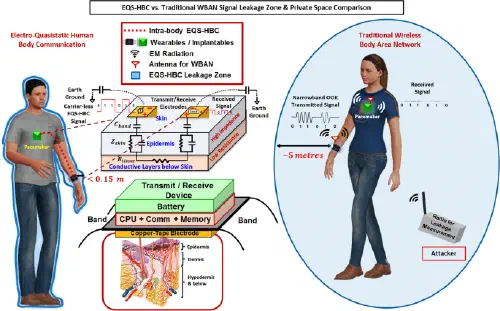
The Purdue trick, described in their 2019 paper in Nature Scientific Reports, is to drop the signal frequency far down the electromagnetic spectrum, into the “electro-quasistatic” regime below about 1 MHz. Down there, the wavelength is enormous compared to a human body, so almost nothing radiates. The signal couples capacitively into your skin at the transmitter (say, a watch), travels along your conductive tissue, and is picked up by a receiver elsewhere on the body. The return path closes through the earth’s ground — a slightly mind-bending detail, but it’s the same principle as a touch lamp.
The measured numbers are what make this interesting. In the experiments, signals from a conventional on-body radio could be detected more than 5 meters away. With EQS-HBC, the leakage around the device itself was detectable only within about 15 centimeters, and the signal carried by the body alone leaked roughly 1 centimeter beyond the skin. An eavesdropper would essentially have to touch you to snoop the channel. As a bonus, because the body is a low-loss channel, prototype circuits ran on about 100 times less energy than Bluetooth Low Energy — a big deal for devices the size of a pill or a hearing aid, where every microwatt counts. The group’s biophysical modeling work digs into why the channel behaves this way and how to optimize it.
Data that only flows when you touch
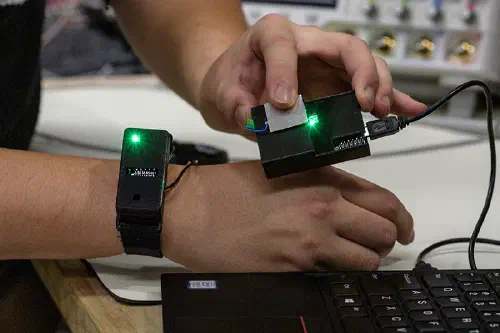
The most intuitive demo of this technology is what the team calls BodyWire-HCI: communication that happens strictly during touch. Wearing a prototype on the wrist, a person could transfer a photo or a password to a laptop simply by touching a sensor pad with a fingertip. Hover that same fingertip one centimeter above the pad, and nothing transfers. In a 2020 demonstration (there’s a short video on YouTube), two adjacent touch surfaces each had a light indicating data reception — touching one lit only that one, showing the data didn’t spill over to its neighbor a few centimeters away.
That property — data transfer gated by physical contact — is hard to get with radio, where “near” is fuzzy. It suggests some very natural interactions: pay at a terminal by touching it, with the credentials coming from the phone still in your pocket. Unlock your front door by grabbing the handle, your wearable providing the key. Exchange contact details through a handshake. None of these require biometrics; they’re ordinary digital credentials, just delivered over an unusual wire.
Beyond one body
Follow-up work has been mapping out the edges of this idea. A 2021 study on inter-body coupling analyzed what happens when two people are near each other or in contact — important both for security (can your channel leak into someone else’s body?) and for deliberate person-to-person transfer. And a 2025 paper in Communications Engineering extended the concept to conductive structures: a metal desk frame or doorframe can become part of the circuit, letting a wearable talk to an off-body device through touch, without any radio pairing step. The team demonstrated streaming a live audio signal through such a human-structure link.
The academic work is also heading toward products. Sen founded a startup, Ixana, to commercialize the technology, and the broader research vision — a low-power, physically secure “Internet of Bodies” connecting wearables, implants, and eventually brain-computer interfaces — is laid out in Sen’s TED talk and in coverage like IEEE Spectrum’s “Turning the Body Into a Wire”.
The caveats
This is still mostly lab-stage technology. For touch-to-pay or touch-to-unlock to work in the wild, surfaces everywhere would need compatible receivers, and your wearable would need sensible rules about when to transmit — you probably don’t want to hand your credentials to every equipped doorknob you brush against. “Physically contained” is also not the same as “unhackable”: it removes the easy remote-interception attack that plagues radio, but endpoint security, authentication, and encryption still matter. And low-frequency channels naturally offer less raw bandwidth than gigahertz radios, though follow-on work keeps pushing data rates up.
Still, the core result stands out for its simplicity: the most private network you own might be the one made of you. Where Bluetooth shouts across the room, EQS-HBC whispers under your skin — and only reaches the things you actually touch.
References
- https://pmc.ncbi.nlm.nih.gov/articles/PMC6411898/
- https://pubmed.ncbi.nlm.nih.gov/33623092/
- https://www.youtube.com/watch?v=NHqfT1vIe6E
- https://arxiv.org/pdf/2010.15339
- https://arxiv.org/pdf/2411.10905
- https://engineering.purdue.edu/~shreyas/SparcLab/