How Heat, Fat, and Sugar Spot Pizza
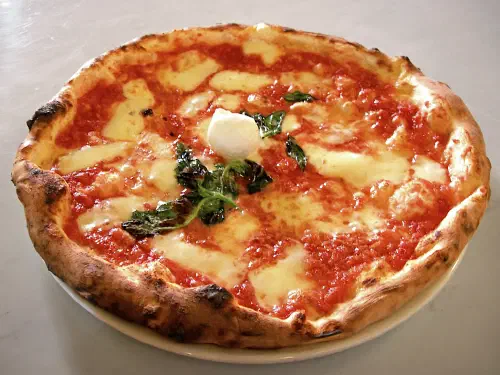
Pull a great pizza out of a blazing oven and look closely at the cheese: it isn’t an even sheet of gold. It’s a landscape of little brown-and-black blisters scattered across a paler background, the pattern pizza nerds call “leopard spotting.” That freckled look is often treated as a matter of taste or luck, but it’s really the visible output of two measurable physical processes running at the same time — a browning chemistry and a bubble-forming mechanics — both tunable by moisture, fat, salt, and how hard the oven pushes heat into the cheese.
The brown part: Maillard chemistry with a dairy twist
The color comes from the Maillard reaction, the same browning that gives seared steak and toast their flavor. It’s a cascade of reactions between reducing sugars and the amino groups on proteins and peptides, producing a mess of brown pigments and roasty aromas. In mozzarella there’s a specific sugar to blame: galactose. The starter bacterium Streptococcus thermophilus breaks lactose into glucose and galactose, ferments the glucose, and leaves the galactose behind. The more residual galactose sits in the curd, the more aggressively the surface browns under high heat.
That link is well established. Cheesemakers can dial browning way down by using galactose-fermenting cultures that clean up the leftover sugar, as shown in early work on low-browning mozzarella where cheeses differing only in galactose content produced visibly different pizzas. It’s a satisfyingly clean experiment: hold everything else constant, change one sugar, and watch the color change. Interestingly, when researchers later compared several starter cultures using machine-vision analysis of blistering and browning, cheeses whose cultures produced similar galactose levels browned to similar degrees — the sugar really is the master dial for color.
The blistered part: bubbles, skins, and viscosity
Browning explains the color, but not the spots. Those come from a separate mechanical story that plays out in stages. A detailed PhD study of Mozzarella browning and blistering during high-temperature baking breaks the process into a sequence: the cheese melts and flows, water inside starts flashing to steam, bubbles form and push the surface up, the surface dries, and finally the raised bubble caps blister and brown.
The key insight is that everything hinges on surface drying. As water leaves the surface, the cheese there gets more viscous — thicker and stiffer. Dry it enough and it forms a stable skin; once that skin is in place, the surface temperature can climb past the boiling point of water toward the range where Maillard browning really takes off. So a blister is essentially a steam bubble that got trapped under a drying skin and then toasted on top. That’s also why the browning shows up as discrete spots rather than a uniform tan: the raised, drier bubble caps hit browning temperatures first.
Heat flux is the throttle
How fast the surface dries depends on heat flux — the rate at which the oven pumps energy into the cheese — and that turns out to control the entire look of the spotting. The Massey work fitted the browning to first-order kinetics that follow the Arrhenius law, with an activation energy on the order of 100–120 kJ/mol, which is just a formal way of saying the browning rate is steeply temperature-dependent. Push more heat and you don’t just brown faster; you change the blister pattern itself.
At high heat flux, the surface dries almost immediately. There’s little time for bubbles to grow before a stiff skin locks the surface in place, so you get many small blisters. At low heat flux, the surface stays wet and pliable longer, bubbles have time to grow and merge, and you end up with fewer but larger blisters. In experiments spanning roughly 220–288 °C, hotter ovens produced smaller spots, and the gap between when moisture loss began and when blisters appeared shrank from about five minutes down to about two — a sign that intense heat dries the surface far faster than it dries the cheese as a whole. One tidy result: average blister size tracked heat flux in a nearly straight line. Notably, whether the cheese started as shreds or slices didn’t change where blisters nucleated; time and temperature dominated.
Fat and salt: the quiet regulators
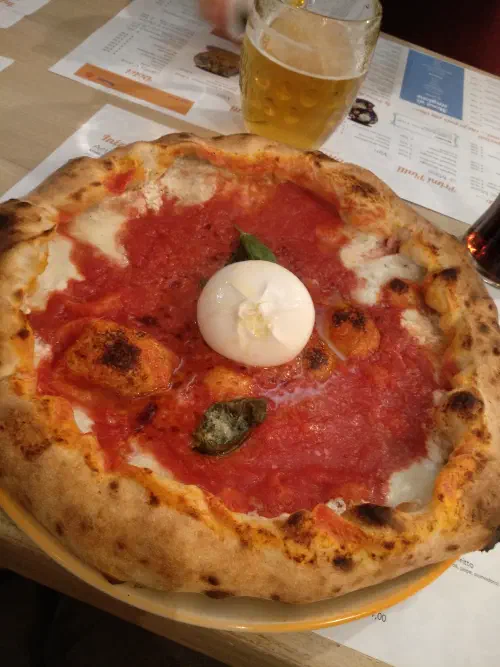
Two more levers change the picture. The first is fat. A classic model of Mozzarella melting and browning during pizza baking showed that full-fat shreds melt, fuse, and form gentle light-brown blisters, while fat-free cheese does something ugly: its surface dries out so fast that it forms a hard brown skin and scorches instead of blistering nicely. The free oil that full-fat cheese releases essentially bastes the surface, slowing moisture loss and keeping the melt supple. Coat a lean cheese with a hydrophobic layer and its melt and appearance improve dramatically — more evidence that surface drying, not fat content per se, is the thing that matters.
The second lever is salt. When researchers quantified blistering and browning across mozzarellas with different salt and moisture contents, higher-salt cheeses had smaller fat globules and lower water activity, which raised their transition temperature and made the melted cheese more elastic and resistant to stretching. That extra stiffness physically restrains bubbles, so higher-salt cheeses produced smaller blisters. Salt doesn’t rewrite the chemistry so much as change the rheology — how the molten cheese flows and resists — which in turn caps how big a blister can get.
Why machine vision matters
Historically, “good spotting” was a judgment call by whoever was looking at the pizza. The through-line in all this research is replacing that eyeball with a camera. By converting images into the CIELAB color space and tracking lightness over time, then using thresholding to turn photos into black-and-white maps of “blister” versus “not blister,” you can count spots, measure their size and shape, and fit real kinetic curves. That same toolkit lets you compare different cheeses and their color uniformity objectively, correlating appearance with properties like elasticity, free oil, and transition temperature rather than relying on taste-panel vibes.
Put it all together and the leopard on your pizza stops being random. The sugar sets how dark the spots get, the moisture and heat flux set how many and how big, and fat and salt fine-tune the melt underneath. It’s a genuinely physical system — and now a photographable, quantifiable one.
References
- https://onlinelibrary.wiley.com/doi/10.1046/j.1471-0307.2003.00109.x
- https://www.journalofdairyscience.org/article/S0022-0302(25)00678-2/fulltext