Food-Waste Powder in Pizza Bases
Onion skins are usually treated as packaging supplied by nature: useful until the bulb reaches the chopping board, then discarded. Chemically, though, those papery layers are unusually concentrated plant material, rich in fiber and phenolic compounds such as quercetin. That makes them an interesting candidate for “upcycling” into flour-based foods—provided the resulting food still behaves and tastes like food.
A 2020 study in Scientific Reports tested that idea in pizza bases. The researchers cleaned red-onion skins, freeze-dried them, ground them into a powder, and used it to replace 2%, 3.5%, or 5% of refined wheat flour. They then measured the dough’s mechanical behavior, the baked base’s texture and color, antioxidant-related chemistry, sensory acceptance, and microbial growth during storage.
Dough Is Both Springy and Flowing
Pizza dough is viscoelastic: it behaves partly like an elastic solid and partly like a thick liquid. A rheometer can separate those tendencies into two useful measurements. The storage modulus, G′, describes the energy temporarily stored when the dough is deformed—roughly its springy, solid-like side. The loss modulus, G″, describes energy dissipated through flow—its viscous side.
In the experiment, G′ remained above G″, so every formulation was predominantly solid-like under the test conditions. More importantly, adding onion-skin powder increased G′ in a clear sequence: control, 2%, 3.5%, then 5%. The effect also became stronger as the oscillation frequency increased.
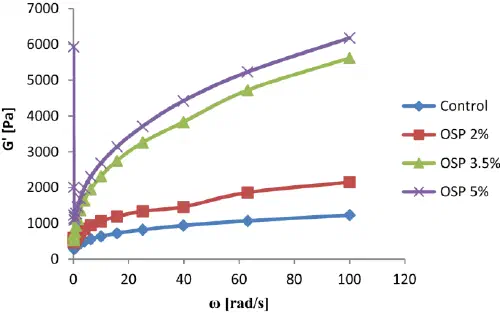
Why? The powder does not simply add flavor molecules. Its fiber absorbs water and occupies space inside the dough matrix, while its phenolic compounds can interact with proteins and starch. Together, these changes make the dough more resistant to deformation. Similar concentration-dependent changes have appeared in bread made with industrial onion-waste powder and in a recent study using onion-peel extract in high-gluten dough.
“Stronger,” however, does not automatically mean “better.” Pizza dough must stretch, trap fermentation gases, and remain tender after baking. A dough that becomes too rigid may be harder to shape and may produce a denser base.
The Antioxidant Gain Is Real
The chemical results were less ambiguous. Total phenolic content increased sharply: the 2% and 3.5% bases contained roughly eight and nine times as much as the control, while the 5% formulation was highest. Total flavonoids and antioxidant activity also climbed with the amount of powder.
The researchers checked antioxidant activity with three common laboratory assays—DPPH, ABTS, and FRAP. In the 5% base, the measured activity was approximately 50 times, eight times, and four times the control result, respectively. These tests do not prove that eating the pizza produces equivalent effects inside the human body, but they do show that useful onion-skin compounds survived mixing and baking well enough to remain chemically active in the finished base.
The fiber also changed how the base handled liquids. Water-holding and oil-holding capacity both increased with the powder concentration. That can affect mixing, perceived moisture, flavor retention, and staling, but it also means a commercial recipe would probably need hydration and processing adjustments rather than a simple gram-for-gram flour swap.
The Crust Gets Darker and Harder
The most visible change was color. Increasing amounts of red-onion-skin powder turned the dough and baked bases progressively darker and more reddish-brown. The physical comparison is striking:
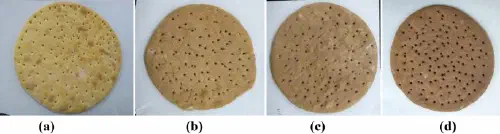
Texture shifted in the same direction. Instrument-measured hardness rose from 8.54 newtons in the control to 10.12 N at 2%, 11.44 N at 3.5%, and 14.87 N at 5%. Chewiness also increased. A 50-person sensory panel preferred the 2% version overall; the 5% base scored poorly for color, odor, flavor, and mouthfeel.
That result points to a familiar food-engineering compromise. The highest dose delivered the strongest antioxidant measurements, but the lowest fortified dose produced the most acceptable pizza base. Functional ingredients rarely have a single optimum: the chemical optimum, processing optimum, and eating-quality optimum may all occur at different concentrations.
Shelf Life Improved, but Not Simply
The fortified bases generally developed lower microbial counts than the control during the earlier storage checks, consistent with antimicrobial activity associated with onion phenolics. Refrigeration was still the dominant preservation factor. At room temperature, visible fungal spoilage appeared after about a week; under refrigeration, visible spoilage appeared after day nine.
There is also an important wrinkle: on the final refrigerated test day, the 5% base had the highest fungal count. So the study supports the idea that onion-skin powder can delay early microbial growth, not that increasing the dose guarantees a proportionally longer safe life. Packaging, sanitation, moisture, temperature, and the organisms present remain decisive.
Promising Ingredient, Early Evidence
This was a controlled experiment on plain, pre-baked bases—not a pizzeria trial with high-temperature baking, sauce, cheese, and variable fermentation. The researchers also selected one onion cultivar for its especially high phenolic content and produced the powder through washing, 48 hours of freeze-drying, fine grinding, and cold storage. Untreated kitchen peel is therefore not equivalent to the standardized ingredient used in the study.
The processing method raises a sustainability question too. Turning a discarded stream into food is attractive, but freeze-drying is equipment- and energy-intensive. A practical ingredient would need food-safe collection, contamination control, economical drying, consistent particle size, and recipe-specific testing.
Even with those caveats, onion-skin powder is a neat demonstration of food-waste fortification. A small amount can noticeably change the physics of dough, carry antioxidant compounds through baking, and slow some early microbial growth. The useful target is probably not the maximum possible dose, but the point where waste reduction and added functionality arrive without making the pizza base too dark, hard, or onion-forward.
References
- https://www.ncbi.nlm.nih.gov/pmc/articles/PMC7596091/
- https://www.sciencedirect.com/science/article/pii/S0308814620304246
- https://www.sciencedirect.com/science/article/pii/S0023643819309569
- https://www.curresweb.com/csi/csi/2014/468-475.pdf
- https://doi.org/10.1016/j.foodchem.2012.09.151