Flushing Taps Doesnt Always Beat Legionella
You’ve probably heard the advice: after a long vacation, or when an empty rental has sat idle for a while, run every tap for a few minutes before you drink, shower, or brush your teeth. The logic feels airtight. Water that sits still goes “stale,” bacteria multiply, so you rinse the old water out and swap in fresh. Simple.
Except the science turns out to be messier than that. A handful of recent field studies — several prompted by the enormous natural experiment of COVID-19 lockdowns, when whole office towers sat unused for weeks — found that flushing sometimes increases the very bacteria you’re trying to get rid of, at least for a while. Whether flushing helps, hurts, or does nothing depends on your pipes, your water heater, and even whether your plumbing is copper or plastic.
What’s actually growing in there
The bug at the center of this story is Legionella, a genus of bacteria that lives in freshwater and, given the chance, colonizes the warm, low-flow corners of building plumbing. Breathe in contaminated droplets — from a shower, say — and it can cause Legionnaires’ disease, a serious form of pneumonia. It isn’t a stomach bug from drinking; it’s a lung problem from mist.
Legionella doesn’t drift around freely so much as it hides inside biofilm, the slimy microbial film that coats the inside of every pipe. It often shelters within amoebae living in that biofilm, which makes it stubbornly hard to kill. The two things it loves most are lukewarm water (roughly 25–45 °C, exactly the range between a cold line warmed by the room and a hot line that has cooled off) and time to grow undisturbed. “Stagnation” — water sitting still — seems like the obvious villain. The recent research complicates that instinct.
The Swiss surprise: flushing that backfires
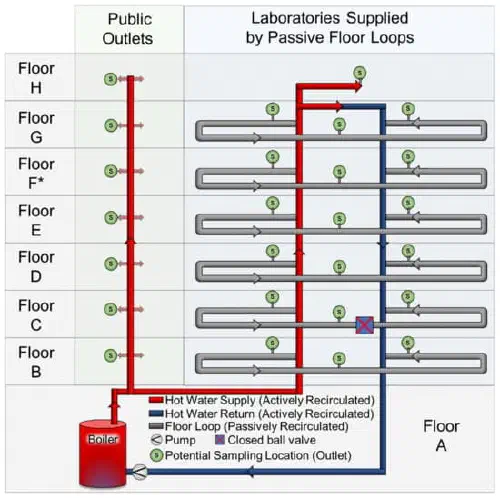
Researchers at Switzerland’s Eawag aquatic institute had a rare gift: an office-and-lab building they had already been monitoring for Legionella for years when lockdown hit. In their 2022 study, they tracked the bacterium before, during, and after seven weeks of near-empty occupancy — and the response was all over the map. Across different low-demand periods they recorded no change, a greater-than-4-log jump (that’s over 10,000-fold), and a 1.5-log drop. Stagnation alone simply didn’t predict the outcome.
The genuinely counterintuitive part came next. When staff dutifully flushed every outlet before returning to work — the textbook precaution — Legionella in the hot-water system briefly went up, by more than a log, before settling back down over a few weeks. Follow-up experiments pinned down why. Blasting the boiler with a big, fast flush drained its hot water faster than it could reheat, wiping out the roughly 60 °C “thermal barrier” that normally keeps the tank hostile to bacteria. The rush of water also sheared loose chunks of biofilm and delivered a fresh load of nutrients — in effect feeding and scattering the bacteria rather than flushing them away. Tellingly, a gentler flush that kept the water genuinely hot did not cause the spike; a rapid, cooling one did.
One important caveat: the Eawag building runs on non-chlorinated water, which is common in Switzerland and much of Europe. With no disinfectant residual in the pipes, there is nothing to mop up bacteria that get stirred loose.
But the opposite can also be true
If that were the whole story, the takeaway would be “never flush.” It isn’t. A University of Michigan team reached nearly the opposite conclusion. Sampling a public building 192 times through lockdown and reopening, their 2023 study found that long stretches of stagnation did let Legionella populations build up, and that avoiding stagnation plus regular flushing helped keep the water in check. Their plain-language summary was blunt: there is no known safe level of Legionella, and routine flushing and monitoring matter, especially for buildings that go through long closures.
Both things can be true because “stagnation” is a slippery word. It can mean an overnight pause at one tap or a year-long dead-end pipe, and the water chemistry, temperature, and leftover disinfectant all pull the result in different directions. Earlier work, including a widely cited 2020 study, likewise found that flushing reduced infection risk in stagnant systems. The honest summary is that flushing is a tool with real limits, not a magic reset button.
Plastic vs. copper, hot vs. cold
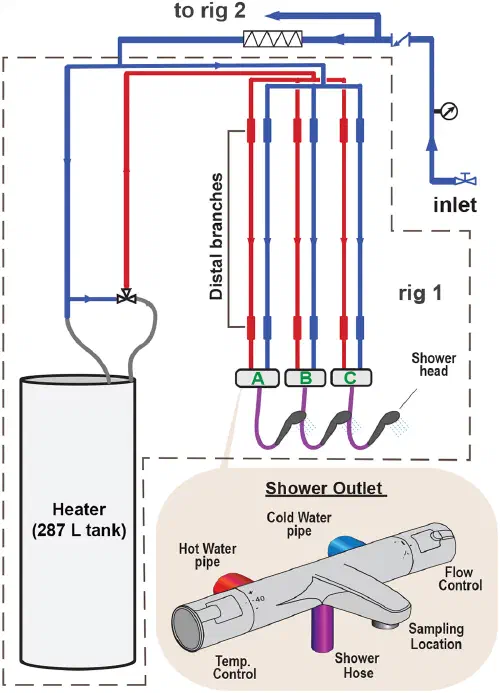
A 2023 pilot study from Norway and Minnesota isolated the variables in a way real buildings never allow, running two parallel plumbing rigs on non-chlorinated water. Three findings stand out for anyone thinking about their own home.
First, flushing bought surprisingly little. A five-minute flush knocked bacteria down immediately, but the benefit that lingered afterward was under half a log — trivial in practice. During long idle periods, flushing made essentially no difference: ordinary bacteria rebounded to full strength in about 3 days, and Legionella climbed steadily over roughly 12 days whether or not the pipe had recently been flushed.
Second, hot flushing wasn’t magic. Even 60 °C water gave barely more benefit than cold, because the bacteria hiding in biofilm largely rode it out.
Third — and most relevant to home renovations — the pipe material mattered. Legionella turned up more often in the PEX (cross-linked polyethylene) plastic pipes than in copper, and the plastic carried a bit more biofilm overall. Copper has mild antimicrobial properties, while plastics can leach small amounts of organic carbon that feed microbes. The same study also flagged an under-appreciated point: the cold-water lines often harbored as much Legionella as the hot ones — and nobody thinks to run the heater for their cold tap.
So what should you actually do?
For a healthy person coming home from a two-week holiday, the practical risk from your own kitchen tap is low, and the sensible move is unchanged: run the cold and hot taps for a couple of minutes, and let the shower run — pointed at the drain, ideally without standing in the mist — before you use it. It’s cheap, harmless, and it clears out water that has gone lukewarm and metallic.
The nuance from the research is really about large systems and vulnerable people. In hospitals, hotels, schools, and big offices reopening after months of low use, a hasty, aggressive flush can backfire, and the fix is smarter flushing — keeping water genuinely hot, avoiding sudden boiler-draining surges, and monitoring afterward — rather than simply more of it. If someone in the household is elderly, immunocompromised, or has serious lung disease, that’s the case where keeping the water heater at a safely hot setting and not letting rarely-used taps sit idle for months is worth the attention. Public-health agencies such as the CDC publish detailed reopening guidance for exactly these settings.
The bigger lesson is a tidy example of “obvious” advice meeting messy reality. Flushing your taps after a trip isn’t wrong — it’s just not the clean bacterial reset it feels like. Your plumbing is a living system, and like most living systems, it doesn’t respond to a rinse in a straight line.
References
- https://www.ncbi.nlm.nih.gov/pmc/articles/PMC8950775/
- https://pubmed.ncbi.nlm.nih.gov/35336130/
- https://pmc.ncbi.nlm.nih.gov/articles/PMC11503721/
- https://doi.org/10.3389/frwa.2022.958523
- https://www.epa.gov/coronavirus/information-maintaining-or-restoring-water-quality-buildings-low-or-no-use
- https://doi.org/10.1039/D0EW00819B
- https://doi.org/10.3390/microorganisms9061212