Engineers Havent Settled on Why Trains Squeal in Curves
You know the noise. You’re standing on a metro platform, or halfway through a tram ride, and as the train leans into a tight bend the whole carriage erupts into a metallic shriek somewhere between a badly played violin and fingernails on a very large chalkboard. Hands go over ears. Dogs would leave the country. On the worst curves that squeal can reach around 120 decibels right at the rail — loud enough to be a genuine nuisance for passengers, drivers, and anyone unlucky enough to live nearby.

What’s strange is that this is a very old, very common sound — and scientists still argue about exactly what causes it. Most popular explanations stop at “the wheels slip.” That’s true, but it’s the beginning of the story, not the end.
Why a curve makes a wheel scream
Train wheels aren’t independent. On a traditional axle the two wheels are rigidly joined, so they’re forced to spin at the same rate. Engineers get around this on gentle curves with a clever trick: the wheels are slightly cone-shaped, so a wheelset can shift sideways and let the outer wheel roll on a slightly bigger diameter than the inner one, steering itself around the bend. The physics of that self-steering is laid out nicely in this guide to how railway wheels take a curve.
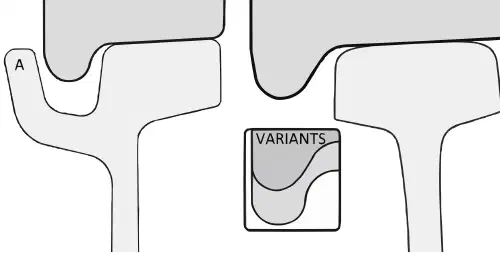
The trick runs out on tight curves. When the radius gets small enough the geometry simply can’t keep up, and the wheel is forced to skid sideways across the top of the rail — a sideways scrubbing that engineers call lateral creepage. That scrubbing feeds energy into the wheel, which then rings like a steel bell at its natural frequencies, usually a piercing tone of a few thousand hertz. (There’s a related but separate “flange squeal” when the outer wheel’s flange grinds against the side of the high rail.)
So far, so agreed. The fight is about the next step: what turns a steady sideways scrub into a screaming, self-sustaining vibration?
Two camps, one squeal
Camp one: falling friction. The oldest explanation, dating back to the 1970s, blames the way friction changes with sliding speed. If friction drops as the wheel slides faster — a “negative slope,” or falling-friction characteristic — then the contact starts behaving like a source of negative damping. Instead of calming vibrations down it pumps them up, driving the classic “stick-slip” cycle where the surfaces alternately grip and release thousands of times a second. This is the picture that most overviews of the stick-slip mechanism still lead with.
Camp two: mode coupling. More recently, researchers showed that squeal can happen even when friction is perfectly constant — no negative slope required. The idea is that two of the wheel’s vibration modes (say, one mostly vertical and one mostly sideways) can have similar frequencies, and friction links them so that energy sloshes back and forth between them. Once coupled, the pair becomes unstable and the wheel sings. A tell-tale fingerprint of mode coupling is that the squeal frequency can sit between the two modes rather than exactly on either one, with a characteristic phase difference between the vertical and lateral motion. A state-of-the-art review of curve squeal lays out both mechanisms side by side, and a careful assessment comparing mode coupling and falling friction has tried to pin down when each one takes over.
The awkward truth is that both mechanisms are real, and both can produce something that looks and sounds like curve squeal. That’s exactly why the argument hasn’t ended.
Why the debate won’t die
Part of the problem is that squeal is a nightmare to measure. It’s intermittent — screaming on one pass, silent on the next — and it depends on humidity, temperature, wheel wear, and exactly where the wheel is sitting on the rail. Models can reproduce the noise using either mechanism, so matching a simulation to a recording doesn’t actually prove which piece of physics dominates out in the real world.
Recent work has tried to close that gap with better experiments. A 2022 study combined an in-situ experiment on an operating metro line with a full 3D transient model, and by varying things like contact angle, angle of attack and direction of rotation, the authors concluded that the flange squeal they measured was being driven by mode coupling. Other groups have found that small details — like a second contact point, where the wheel touches the rail in two places at once — can actively encourage mode coupling. It increasingly looks less like “which camp is right” and more like “which mechanism wins under these specific conditions.”
Silencing a noise we can’t fully explain
Here’s the fun engineering irony: even without a settled theory, we’ve gotten pretty good at shutting the squeal up.
The star player is the friction modifier — a water-based gel applied in a thin film to the top of the rail. Unlike grease, it isn’t really a lubricant; it’s tuned to have positive friction, meaning friction rises as the wheel slips more. That directly cancels the falling-friction mechanism and damps out stick-slip, while keeping enough grip that trains can still accelerate and brake. Products like KELTRACK have been shown in field trials to control squeal substantially, and modelling of squeal under friction modifiers backs up why. These gels can be sprayed from trackside boxes or, increasingly, carried on board the train itself.
Geometry helps too. Reshaping the rail head by grinding — including asymmetric rail profiles that are ground differently on the inner and outer rails — can spread the contact and improve how the wheelset steers, so it scrubs less in the first place. A UIC benchmark flagged asymmetric rail profiles as a promising measure, though they’re fiddly to get right, and clumsy grinding can even make things worse by creating that troublesome two-point contact.
None of it is a magic bullet. Squeal is famously an “on-off” phenomenon — it’s either there or it isn’t — so mitigation is really about nudging a particular curve out of its danger zone. Which brings us back to the mystery: we can often stop trains from screaming before we’ve fully agreed on why they scream in the first place. For a noise this old and this annoying, there’s something oddly satisfying about that.
References
- https://www.sciencedirect.com/science/article/abs/pii/S0022460X14002892
- https://www.inm.uni-stuttgart.de/institut/mitarbeiter/leine/papers/journal_publications/Glocker_x_Cataldi_x_Leine_-_Curve_squealing_of_trains_measurement_modelling_and_simulation.pdf
- https://www.acoustics.asn.au/conference_proceedings/INTERNOISE2014/papers/p1010.pdf
- https://www.sciencedirect.com/science/article/pii/S0003682X24000136
- https://www.tandfonline.com/doi/full/10.1080/10402004.2025.2479074
- https://asmedigitalcollection.asme.org/tribology/article/146/6/061501/1194228/A-Root-Cause-of-Curve-Squeal-Self-Excited
- https://www.sciencedirect.com/science/article/abs/pii/S0022460X03007399
- https://www.railwaygazette.com/sponsored-content/friction-modifiers-move-from-trackside-to-on-board/67153.article
- https://en.wikipedia.org/wiki/Comparison_of_train_and_tram_tracks