Ditch Batteries With Indoor Perovskite Solar Cells
Powering Your Smart Home With Room Light: The Magic of Perovskite Solar Cells.
If you’ve spent any time building a smart home, you already know the frustration of the inevitable “low battery” ping. Whether it is a temperature monitor tucked in the corner of your living room, a smart lock on your front door, or a humidity sensor in your basement, the Internet of Things (IoT) runs on a sprawling network of disposable batteries. Replacing them isn’t just an annoyance; it’s a massive environmental problem. But what if your devices could simply siphon all the electricity they need from the glow of your ceiling lamps?
Welcome to the era of indoor photovoltaics (IPVs). While traditional solar panels require direct, blazing sunlight to perform effectively, a new class of materials is conquering the dim, scattered light of our living rooms. By engineering advanced solar cells known as perovskites, researchers have successfully converted everyday household lighting into electricity at over 40% efficiency. This breakthrough is enough to permanently power your battery-free IoT sensors without you ever needing to pop out a dead coin-cell again.
Why Traditional Silicon Fails Indoors
We are used to seeing giant, dark blue silicon solar panels on rooftops, soaking up the broad spectrum of radiation emitted by our sun. Silicon is fantastic for this job. However, bring a silicon solar cell inside your house, and its efficiency plummets.
Indoor environments are illuminated by artificial light sources—like LEDs or compact fluorescent bulbs—that emit a very narrow, specific spectrum of visible light, usually operating at less than 1,000 lux (compared to 100,000 lux outdoors). Silicon’s chemical “bandgap”—the amount of energy required to kick an electron loose and create a current—is mismatched for this indoor lighting. Most of the energy from indoor light simply passes right through the silicon or gets lost as heat.
The Perovskite Advantage
Enter perovskite solar cells. Perovskites aren’t a single chemical, but rather a family of materials that share a highly specific, tunable crystal structure. To materials scientists, perovskites are essentially a sandbox; by slightly altering the recipe—for instance, by mixing different ratios of elements like Cesium, Formamidinium, or Bromine—they can perfectly modify the material’s bandgap.
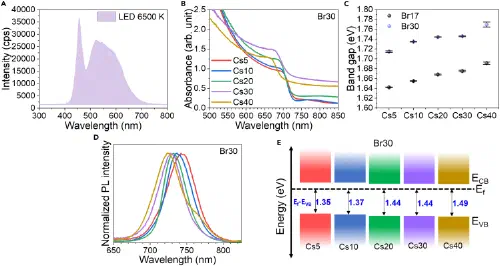
By tuning the bandgap to around 1.8 to 1.9 electron-volts (eV), a perovskite solar cell becomes an absolute sponge for the exact light frequencies emitted by your indoor 3000 K or 6500 K LED bulbs. Instead of wasting energy, the cell efficiently captures these indoor photons. A recent study on triple cation perovskites demonstrated how carefully balancing Cesium and Bromine concentrations allows these indoor cells to achieve ultralow energy hysteresis and incredibly high light-absorption under standard household LEDs.
Transporting the Charge: The 40% Breakthrough
Creating an electrical current requires more than just knocking an electron loose; you have to cleanly transport that negative electron to one side of the battery circuit, and the remaining positive void (known as a “hole”) to the other. If the electron and the hole bump back into each other before they reach their respective electrodes, they recombine, and the electrical energy is instantly lost.
This recombination has historically capped the efficiency of indoor solar cells. However, a massive leap forward occurred recently thanks to international collaborations focusing on the “hole-transporting layer” of the cell. According to research from Kaunas University of Technology and Ming Chi University of Technology, chemists synthesized novel hole-transporting organic semiconductors—specifically, thiazol[5,4-d]thiazole derivatives.
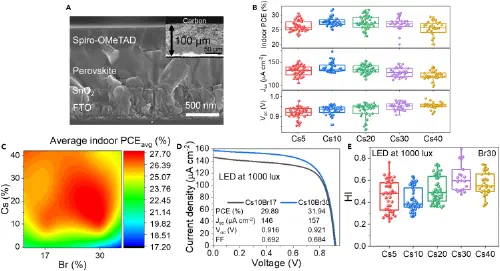
When layered into a perovskite solar cell, these new materials act as a selective bouncer: they rapidly usher the positive charges to the electrode while firmly blocking the negative electrons. This drastically reduces recombination losses. With these structural advancements, indoor perovskite solar cells now convert dim household lighting to electricity at over 37% to 40% efficiency.
A Battery-Free IoT Future
So, what does a 40% conversion efficiency under dim lighting actually mean for you?
An IoT sensor—such as a smart thermostat, a door-ajar monitor, or a Bluetooth humidity tracker—typically draws only a few microwatts of power while in sleep mode, and short bursts of milliwatts when transmitting data. A tiny perovskite indoor solar cell, no larger than a postage stamp, can generate more than enough continuous electricity from your living room lamp to keep a small capacitor fully charged.
As manufacturing processes improve and environmental stability issues are ironed out, we are looking at a future where smart devices are truly set-and-forget. By harvesting the ambient light we already use to see, perovskite photovoltaics will weave our digital networks into the background of our lives—permanently cutting the cord on the disposable battery.
References
- https://iopscience.iop.org/article/10.1088/2515-7655/ade5c8
- https://www.sciencedirect.com/science/article/abs/pii/S0038092X24007448
- https://pubs.rsc.org/en/content/articlelanding/2024/EE/D4EE00438F
- https://pubs.acs.org/doi/10.1021/acsenergylett.2c02050