Copying Owls to Silence Drones and Fans
Owls are the assassins of the bird world: big, fast, and almost completely silent. A barn owl can drop onto a mouse from a few meters away and the mouse never hears it coming. That silence isn’t magic — it comes from three specific features on the wing, and over the last few years engineers have been measuring exactly how each one works so they can copy it onto spinning blades. The payoff is quieter drones, fans, and wind turbines, sometimes with more thrust rather than less.
Three tricks hiding on a feather
Biologists have long pointed to three structural features that set owl feathers apart, neatly summarized in a 2025 review of owl-flight aeroacoustics by Rong and Liu.
The first is a leading-edge comb: a row of stiff, hooked barbs sticking out from the front edge of the wing, like the teeth of a comb. It trips the incoming air into many small, controlled swirls instead of one big messy one.
The second is a trailing-edge fringe: soft, flexible hairs that hang off the back edge, right where the airflow from the top and bottom of the wing collide. That collision is where most wing noise is born, and the fringe softens it.
The third is a velvety surface: a downy coating across the top of the wing that acts like a plush carpet, damping the high-frequency hiss of air scraping over the feathers.
Put together, these features attack noise at every point where air touches the wing. The interesting engineering question is how much each one is really worth in decibels — and whether you can bolt it onto a machine.
Copying the feather onto a propeller
Drones are the obvious target, because a quadcopter’s whine comes almost entirely from its propellers. A 2020 study in the Journal of Bionic Engineering took the leading-edge idea and cut sawtooth serrations into the front of a UAV propeller. The best design shaved off about 2.4 dB on average (up to 4.2 dB), while raising thrust by 3.5%. On a hovering quadcopter it cut roughly 4.7 dB at 5 meters — the kind of difference you’d clearly hear.
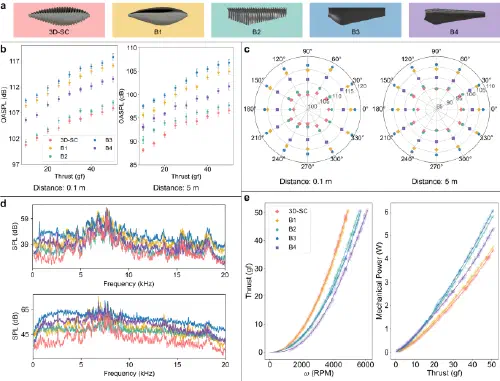
Things got more ambitious in 2024. A Berkeley team writing in Nature Communications combined the owl’s 3D surface serrations with the wing shape of a cicada — an insect that turns out to be a surprisingly efficient flyer. Their hybrid “3D sinusoidal cicada” propeller cut overall sound by up to 5.5 dB versus a commercial DJI benchmark, and — this is the headline — improved propulsive efficiency by more than 20% at the same time. Noise fixes usually cost you performance; this one paid for itself.
Then in 2025, a group in Physics of Fluids tried gluing both the leading-edge comb and the trailing-edge fringe onto the same blade. Their coupled design hit a maximum 3.1 dB reduction plus a 7.9% bump in thrust efficiency, and it kept a useful 2.6–3.8 dB of quieting even several meters away in outdoor tests. A separate 2025 simulation study of larger drone propellers found the leading-edge combs alone were worth about 3 dB, though there they came with a small 4–8% efficiency penalty — a reminder that results depend heavily on blade size and speed.
Why does a bumpy edge get quieter?
It sounds backwards that adding jagged teeth to a smooth blade makes it quieter. The trick is what happens to the little tornadoes — vortices — that form along the edges of any moving wing.
A smooth edge tends to shed air in big, coordinated pulses, and big coordinated pulses are exactly what your ear registers as a tone. Serrations break that process up. The 2023 trailing-edge study from Chiba University built two full 3D models of a real owl wing, one with the fringe and one without, and simulated the airflow. The fringe did two things: it chopped up the vortices rolling off the back edge, and it stopped the airflow around neighboring wingtip feathers from interfering with each other. The result was less noise with basically no loss of lift — and the effect was strongest at the steep wing angles owls actually use when landing.
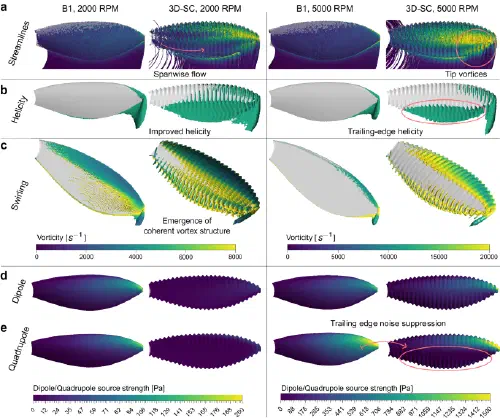
The Berkeley team saw a related mechanism: their 3D serrations coaxed the airflow into forming long, stable “coherent vortex structures” that hang around instead of instantly collapsing into random turbulence. Random, small-scale turbulence is the source of the broadband whoosh you hear from a drone, so keeping the flow organized quiets it across the whole frequency range.
From lab benches to wind farms
This isn’t purely academic. Wind turbines are the biggest commercial success so far. Siemens Gamesa’s “DinoTails Next Generation” are add-on combs and serrations clipped onto the trailing edge of turbine blades, directly inspired by owl wings. They’re credited with cutting turbine noise by more than 10% at all wind speeds without sacrificing energy output — a real win for onshore wind farms that are often forced to run at reduced power just to stay under local noise limits.
The same logic applies to anything with a spinning blade: cooling fans in computers and cars, HVAC systems, even the ducted fans on the “flying car” prototypes people keep promising. The barrier isn’t the idea — it’s manufacturing serrations precisely and cheaply at each product’s size and speed, since (as the drone studies show) a pattern that’s perfect at one RPM can actually make things worse at another.
The catch
None of this makes machines truly silent. Owls evolved their entire wing as a system over millions of years; engineers are still copying one feature at a time and re-measuring what each is worth. The recurring theme across these studies is a tug-of-war between quiet and thrust that you have to tune for a specific blade — but the best recent designs have started to break that tradeoff, getting both at once. And for a maker with a 3D printer and a too-loud drone, owl-inspired serrations are one of the rare bits of cutting-edge aeroacoustics you can actually experiment with at home.
References
- https://techxplore.com/news/2024-01-uncovering-secrets-silent-flight-owls.html
- https://www.sciencedaily.com/releases/2024/01/240123122156.htm
- https://doi.org/10.1088/1748-3190/ad0aa9
- https://www.windtech-international.com/editorial-features/siemens-low-noise-wind-turbine-blades-inspired-by-silent-flight-of-the-owl
- https://www.power-eng.com/renewables/wind-energy/low-noise-wind-turbine-blades-inspired-by-owl-wings/
- https://assets.siemens-energy.com/dam/38332b11-93f7-4745-a036-b34e01182901/siemens-gamesa-dinotails-next-generation-noise-reduction-english-pdf_Original%20file.pdf
- https://en.reset.org/owl-wings-wind-turbine-design/
- https://patents.google.com/patent/US20150233345A1/en