Checking Your Sourdough Into a Hotel
Somewhere near Copenhagen, a hotel guest is being fed twice a day, kept at a carefully controlled temperature, and picked up from home by bicycle. The guest is a jar of beige goo. It has a name, a family history, and an owner who paid real money for the room. Welcome to the strange, surprisingly scientific world of sourdough hotels — and to the microbiology that explains why they exist, what they actually accomplish, and the one thing they never mention at check-in.
What exactly is a sourdough hotel?
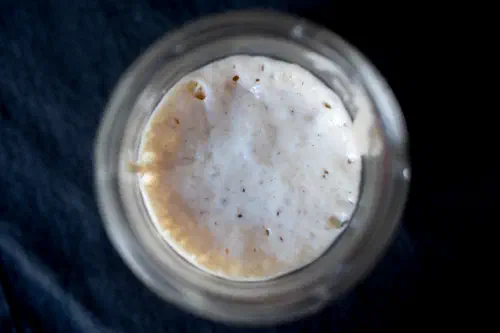
A sourdough starter is a living culture: flour, water, and a dense community of wild yeasts and lactic acid bacteria that leavens bread and gives it its tang. Keep feeding it fresh flour and water and it can live indefinitely — some starters are claimed heirlooms passed down for generations. Stop feeding it, and it slides toward dormancy, off-flavors, or a fuzzy layer of mold.
That maintenance burden collides with vacation plans, and Sweden — a country with five weeks of statutory holiday and a serious sourdough obsession — invented the fix. Around 2011, Stockholm’s Urban Deli launched what Swedish media called the world’s first sourdough hotel, boarding starters for about 200 kronor (roughly $30) a week. A few years later the bakery RC Chocolat opened a 24-hour sourdough hotel at Stockholm’s Arlanda airport, so travelers could literally drop the jar on the way to their gate. The concept made global headlines, with Smithsonian Magazine quipping that boarding bread had become the new doggy day care.
Pricing and the competitive landscape
The market is tiny, charming, and unstable. RC Café’s service reportedly ran about $3 a day or $12 a week, with staff feeding and discarding starters on schedule. The Sourdough Inn, a pop-up outside Copenhagen, charges from about DKK 299 (roughly $47) per week and will even collect your jar by bike. Urban Deli’s original hotel, meanwhile, quietly fizzled: an NPR visit in 2016 found that almost nobody actually checked starters in, and a baker admitted the whole thing had been closer to an art-project-meets-marketing-campaign than a business.
Then there’s the luxury resort of the genre, which takes no paying guests at all. The Puratos Sourdough Library in St. Vith, Belgium permanently houses over a hundred starters from around the world — Klondike Gold Rush survivors, multi-generation family cultures — in refrigerated cabinets, curated by a full-time “sourdough librarian.” Every few months each jar is fed with flour shipped from its home bakery, specifically so its microbial makeup doesn’t drift. That detail is not sentimentality. It is the single most scientifically astute practice in the entire sourdough-hospitality industry, for reasons we’ll get to.
The biology: why starters need room service
A mature “type I” sourdough hosts roughly 100 million to a billion lactic acid bacteria per gram, outnumbering yeasts by 10:1 to 100:1. Regular feeding — what microbiologists call backslopping — dilutes acidic waste products, restocks nutrients, and keeps the pH in the 3.4–4.9 band where this community thrives, according to a 2025 review of sourdough preservation strategies in Foods. Skip feedings and acids accumulate, populations crash, and opportunists move in.
Cold slows all of this down. The same review notes that refrigeration at 4 °C stretches the feeding interval to one or two weeks with viability intact — the dominant sourdough bacterium Fructilactobacillus sanfranciscensis just keeps metabolizing, slowly, in the fridge. But cold is not a pause button. Species tolerate it unevenly, community composition shifts at the margins, and 4 °C does nothing to stop filamentous molds. Freezing is worse: studies reviewed there found drops of around four orders of magnitude in viable bacteria and yeasts after freezing, because ice crystals shred cell membranes.

So the core service a sourdough hotel sells — chilled storage plus scheduled professional feedings — is genuinely the textbook protocol for keeping a starter healthy across a long absence. On the biology, the hotels get it right.
The plot twist: your starter may check out changed
Here’s the part the brochures skip. For decades, bakers assumed starters carried a local terroir — that San Francisco sourdough owed its soul to San Francisco air. In 2021, researchers sequenced 500 starters from four continents in eLife and found little evidence of any geographic pattern at all. What actually structured these communities were microbe-to-microbe interactions and process choices, and much of the variation in aroma and rise rate traced to overlooked acetic acid bacteria. Your starter’s identity, in other words, isn’t where it was born; it’s how it’s kept.
And how it’s kept is precisely what a hotel changes. When Italian researchers propagated seven mature sourdoughs in parallel — identical flour, identical parameters, but one set in artisan bakeries and one in a laboratory — the bacterial communities diverged in five of the seven cases, purely because of the propagation environment. Follow-up work tracking bakeries for a year found that flour batches and the bakery’s resident “house microbiota” — the microbes coating the dough mixers and storage boxes — continually seed and reshape a starter. A commercial hotel feeds your culture with its flour, in its microbe-laden kitchen. A week probably matters little; a long stay is a slow-motion identity transplant. This is exactly why the Puratos library imports each starter’s home flour: it’s the only known way to slow that drift.
What they get right, what they get wrong
Right: the feeding schedule, the cold chain, mold surveillance, and — commercially — the insight that people are emotionally bonded to their microbes. The hotels understood decades before the pandemic sourdough boom that a named starter is a pet, and pets need sitters.
Wrong, or at least unsaid: for a normal one-to-two-week holiday, your refrigerator performs the same service for free. For longer absences, the research literature points to drying a portion of your starter as a robust insurance copy that survives at room temperature. And no hotel will tell you that its loving care, with foreign flour in a foreign kitchen, may quietly rewrite the very culture you paid to preserve.
None of which means the hotels are pointless. They are microbiology outreach with a front desk — proof that fermentation science can charm its way into airports. Just know that when you pick up your bubbling companion, it may have made some new friends. Permanently.
References
- https://www.smithsonianmag.com/smart-news/take-virtual-tour-belgian-sourdough-library-180974668/
- https://news.ncsu.edu/2021/01/the-sourdough-map/
- https://www.tastingtable.com/1620542/puratos-sourdough-library/
- https://journals.plos.org/plosone/article?id=10.1371%2Fjournal.pone.0148325
- https://www.openculture.com/2020/05/take-a-virtual-tour-of-the-worlds-only-sourdough-library.html
- https://www.insidehook.com/culture/tour-world-only-sourdough-library