Bees Are Sampling Microplastics Into Your Honey
When you drizzle honey onto toast, you probably picture a clean product that came straight from a flower. The reality is a little stranger. A honeybee is basically a flying dust mop, and some of the dust it collects is plastic. Over a single season, a colony quietly records the plastic pollution drifting through its neighborhood — and a surprising amount of that record ends up in the jar.
Bees Are Accidental Air Samplers
Bees are covered in branched hairs that evolved to grab pollen. In flight, those hairs pick up a static charge, so they attract tiny particles the way a rubbed balloon attracts your hair. As National Geographic’s reporting on the topic describes, pollen, plant debris, wax, and even bits of other bees get caught this way. Airborne microplastics — plastic fragments and fibers smaller than 5 mm — get caught too.
This isn’t a brand-new trick. Scientists have used bees as pollution “sentinels” for decades, tracking heavy metals, pesticides, and even radioactive fallout. A 2015 study in PLoS ONE showed that bees collect airborne particulate matter that concentrates on specific parts of the body: the edges of the wings, the middle of the head, and the inner surface of the hind legs. Because a foraging bee visits air, soil, water, and vegetation across a range that can stretch for kilometers, it samples a far wider area than any stationary filter ever could.
From the Field, to the Hive, to the Jar
Plastic reaches your honey by two main routes. The first is the environment. When a bee returns to the hive, some of the particles clinging to its body rub off onto comb, wax, and stored nectar. A landmark Danish study in Science of the Total Environment was the first to show worker bees acting as active microplastic samplers. Researchers scrubbed bees from 19 apiaries around Copenhagen and found microplastics everywhere: about 15% of recovered particles were plastic, split into 52% fragments and 38% fibers, made up of 13 different polymers led by polyester, polyethylene, and PVC. City bees carried the most, but suburban and rural bees weren’t far behind — a sign that wind spreads small particles fairly evenly across the landscape.
The second route is us. Honey gets squeezed, filtered, stored, and bottled using plastic equipment and containers, and each step can shed particles. A study of honey from Türkiye pinned packaging as a major source, and the polymer mix in many samples — heavy on packaging plastics — points the same way.
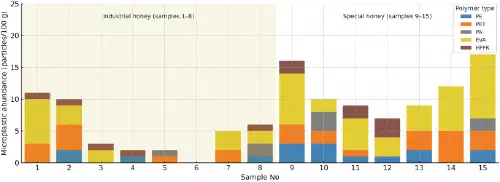
Microplastic abundance in honey samples, grouped by polymer type. Source: Bilecen & Altunışık (2026), npj Science of Food, CC BY 4.0.
What’s Actually in the Honey
A 2026 paper in npj Science of Food put fifteen honeys from Türkiye under a microscope and an infrared scanner. Microplastics showed up in 93% of samples. Interestingly, small-batch “artisanal” honey carried more plastic than industrially processed honey — roughly 11 versus 5 particles per sample — probably because large producers use more standardized, cleaner handling. Most particles were fragments rather than fibers, ranged from about 85 to 1200 micrometers, and were dominated by everyday plastics: ethylene-vinyl acetate, PET, and polyethylene.
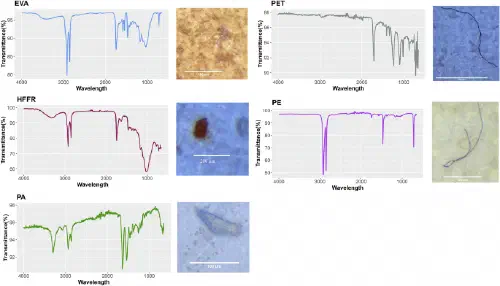
Stereomicroscope images and matching FTIR spectra of selected microplastic particles recovered from honey. Source: Bilecen & Altunışık (2026), npj Science of Food, CC BY 4.0.
Bees don’t just carry plastic on the outside, either. Lab experiments have shown they can swallow microplastics and pass them into honey, wax, and even developing larvae. A 2024 study of a native Brazilian stingless bee found the same double pathway — ingestion plus body contact — and argued these bees make excellent monitors of urban pollution.
A Bioindicator, Not Just a Contaminant
This is where the story gets more interesting than “ugh, plastic in my food.” Because a hive integrates everything within its foraging range, its honey becomes a passive, low-cost record of local plastic pollution — what scientists call a bioindicator. Sampling airborne microplastics is genuinely hard, and most measurements are still taken at ground level. Millions of bees flying millions of tiny transects do that fieldwork for free. Compare honey from two regions and you get a rough readout of how plastic-heavy each environment is.
Should You Stop Eating Honey?
Short version: no. The same npj study estimated that a typical adult eating honey daily swallows only a fraction of a plastic particle per day — on the order of one or two particles a week, adding up to a few thousand over a lifetime. That’s tiny next to seafood, which can deliver hundreds of particles per serving, or tap and bottled water. Honey is a minor contributor to the plastic we ingest, not a hidden mega-source.
That said, “minor” isn’t “zero,” and the particles are worth watching for reasons beyond us. Feeding studies suggest microplastics can shift a bee’s gut microbiome and become more harmful in combination with other stressors — in one experiment, mixing plastic with a common beekeeping antibiotic pushed bee mortality from under 20% to around 55%. The plastic itself is often less dangerous than what it carries or teams up with.
The Honest Caveats
It’s worth staying skeptical of any single number. Microplastic research is notoriously prone to lab contamination — stray fibers from clothing or dust can masquerade as real findings — which is why careful studies run blank samples, wear natural fibers, and keep their glassware covered. Early on, some researchers even doubted whether honey was meaningfully contaminated at all. The current weight of evidence says it is, but concentrations swing widely between regions, producers, and methods, so treat specific counts as ballpark figures rather than gospel.
Even so, the big picture is hard to dodge: plastic is now common enough in the air that a bee can’t help but collect it, and honey has quietly become one of the sweetest records we have of just how far those particles travel.
References
- https://doi.org/10.3390/microplastics3040036
- https://besjournals.onlinelibrary.wiley.com/doi/10.1111/1365-2664.70030
- https://link.springer.com/article/10.1007/s11356-024-34184-y
- https://pubs.acs.org/doi/10.1021/acs.est.1c01619