Battery-Free IoT That Talk by Reflecting Signals
Most wireless gadgets share one stubborn habit: they make their own radio signal, and that costs power. A Wi-Fi chip has to spin up an oscillator and drive a power amplifier just to shout a few bits across the room, which is a big reason your smart sensors still need batteries or a wall socket. Ambient backscatter flips that logic on its head. Instead of producing a signal, a device “talks” by subtly reflecting the radio waves already bouncing around us — the Wi-Fi from your router, a TV broadcast tower, an FM station, even Bluetooth. Done well, the whole thing runs on microwatts and needs no battery at all.
Talking by reflecting, not shouting
The trick lives in the antenna. Any antenna reflects some of the radio energy that hits it, and exactly how much it reflects depends on what’s connected behind it. A backscatter tag exploits this by flipping an electronic switch that changes its antenna between two states — roughly, “absorb” and “reflect.” Switch to one state to signal a 0, switch to the other to signal a 1, and you’ve encoded data into the reflections without ever generating a wave yourself.
The classic way to picture it is two battery-free gadgets, usually nicknamed Alice and Bob, sitting near an ambient signal source. As this walkthrough of the basic handshake explains, Alice modulates her reflections of a nearby signal, and Bob detects the faint change in the signal reaching his own antenna and decodes the bits. Neither device transmits in the normal sense. They’re more like two people flashing messages by tilting a mirror in the sun — the sun (the ambient signal) does the hard work of producing the light.
From TV towers to your Wi-Fi router
The idea went from clever theory to working hardware in 2013, when University of Washington engineers first demonstrated ambient backscatter using ordinary TV broadcast signals. Their battery-free prototypes could swap simple messages and blink an LED at about 1 kilobit per second, over a range of a couple of feet. Not fast, but remarkable for devices with no power source of their own.
Things scaled up quickly once researchers pointed the technique at Wi-Fi. A follow-up called Passive Wi-Fi generated standard 802.11b transmissions that off-the-shelf phones and routers could decode, reaching up to 11 megabits per second while drawing tens of microwatts — on the order of 10,000 times less power than a conventional Wi-Fi chipset. A cousin project, inter-technology backscatter, even reflected a Bluetooth signal to synthesize a Wi-Fi packet, sending 2 Mbps for around 28 microwatts. The work was commercial enough to spin off a startup, and it turned “battery-free networking” from a lab curiosity into a serious engineering direction.
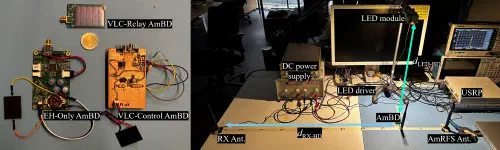
Crucially, TV and Wi-Fi aren’t the only options. As an overview of ambient RF sources lays out, tags can ride FM radio, cellular signals, TV broadcasts, Wi-Fi access points, Bluetooth, and more — each with different power levels and coverage. TV towers are strong and predictable; Wi-Fi is weaker but everywhere. The environment becomes a free, always-on power grid and communication medium rolled into one.
Why it sips power instead of gulping it
The reason backscatter is so frugal comes down to what actually eats power in a radio. Generating a clean carrier wave — the job of an oscillator, mixer, and power amplifier — is the expensive part, typically costing anywhere from hundreds of milliwatts up in an active transmitter. A backscatter device skips all of that. It borrows a carrier that some other transmitter is already producing and simply toggles a switch to nudge the reflections. Flipping a switch is nearly free, which is how a tag can run at microwatt levels and sip enough energy from the environment to stay alive without a battery.
That low budget is what makes true battery-free operation realistic. Many of these devices pair backscatter with energy harvesting, storing tiny amounts of scavenged power from light or radio waves in a capacitor, then waking up to send a reading only once they’ve banked enough charge.
Where you’d actually use it
Battery-free tags aren’t going to stream video to your TV, but that’s not the point. They shine anywhere you want lots of cheap sensors that never need a battery change. A helpful explainer on battery-free and Ambient IoT runs through the obvious targets: soil and crop sensors scattered across farmland, item-level tags for supply chains and warehouses, wearable health monitors, and switches and sensors baked into smart buildings. The recurring theme is scale — deploying so many nodes that swapping batteries would be a logistical nightmare.
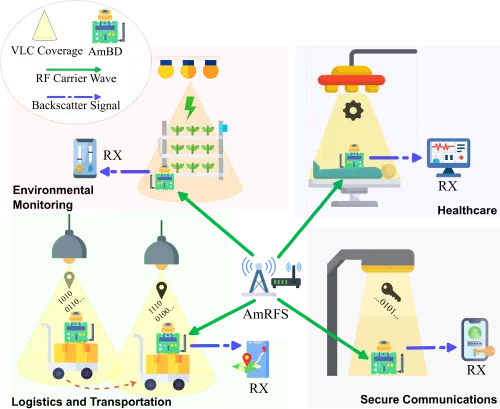
This vision even has a formal name now. Standards bodies have started grouping these ideas under “Ambient IoT,” and recent research on joint light-and-radio backscatter systems frames it as a path toward energy-neutral devices numbering in the trillions — sensors so cheap and maintenance-free you can embed them into everyday objects and simply forget about them.
The catches
None of this is free of trade-offs. The biggest headache is that a backscattered signal is extremely weak, often buried under the far stronger original signal arriving directly at the receiver — the classic “hearing a whisper next to a loudspeaker” problem. Range for pure ambient setups is usually short, from centimeters to a few meters, and the ambient source is uncooperative: your router or the local TV tower has no idea it’s being used as a carrier, so its strength wanders unpredictably. On top of that, tags have to coexist politely with the real Wi-Fi and Bluetooth traffic they’re piggybacking on, which is why standardization and interference management are active areas of work.
Researchers are chipping away at these limits. Some long-range backscatter experiments have pushed communication out to roughly 130 meters by riding FM radio signals and using clever spread-spectrum encoding to pull the faint reply out of the noise. Data rates, range, and reliability all keep creeping upward as the signal-processing tricks improve.
Why it matters
Strip away the jargon and ambient backscatter is really about removing the battery from the Internet of Things. Batteries are the part that dies, leaks, and eventually gets tossed — billions of them, many stuffed with unpleasant metals. A sensor that harvests its own power and talks by reflecting signals could stay in place for a decade or more, then keep going. That’s the difference between an IoT you have to babysit and one you can scatter by the trillion and leave alone. It won’t replace your phone’s radio, but for the quiet, low-data corners of the connected world, whispering with borrowed signals might turn out to be exactly enough.
References
- https://www.sciencedirect.com/science/article/abs/pii/S1389128624008612
- https://www.academia.edu/143165565/Wi_Fi_Backscatter_for_Low_Power_IoT_Review_and_Research_Outlook
- https://www.electronicdesign.com/technologies/test-measurement/article/21203519/ambient-backscatter-powers-battery-free-wireless-communication