Acrylamide Formation and Leavening in Pizza Dough
The Physics and Chemistry of Neapolitan Dough: How Leavening Time Tracks Acrylamide in Wood-Oven Pizza
If you have ever stared into the glowing hearth of a 485°C wood-fired oven while a Neapolitan pizza blisters and bubbles into perfection in under 60 seconds, you are witnessing one of the most intense culinary physics experiments on earth. Making great pizza is often treated as an art form passed down through generations, but underneath the flour and wood smoke lies a fascinating interplay of rheology, enzyme kinetics, and thermal chemistry.
For nerdy home bakers and dough enthusiasts, extended leavening—letting dough ferment for 24 to 48 hours—is the holy grail of pizza making. We know that long fermentation yields a crust that is easier to stretch, lighter on the stomach, and packed with complex aromas. But what actually happens on a micro-structural level as dough matures over two days? And more importantly, does unlocking all those simple sugars and free amino acids during a long fermentation increase the formation of acrylamide when the dough blasts against a red-hot oven floor?
A fascinating comprehensive study published in PubMed Central explores this exact question by tracking dough physiology, starch digestibility, and contaminant formation across a 48-hour timeline. Let’s dig into the science of what happens between the mixing bowl and the wood fire.
The Rheology of Relaxation: Why 16 to 24 Hours is the Sweet Spot
When water meets refined soft wheat flour (typical Italian Tipo “00”), glutenin and gliadin proteins link up to form an elastic network called gluten. Early on, this network is tight, rigid, and stubbornly resists stretching. If you try rolling or slapping out a dough ball immediately after mixing or after just four hours of resting, it acts like a rubber band, snapping back into place.
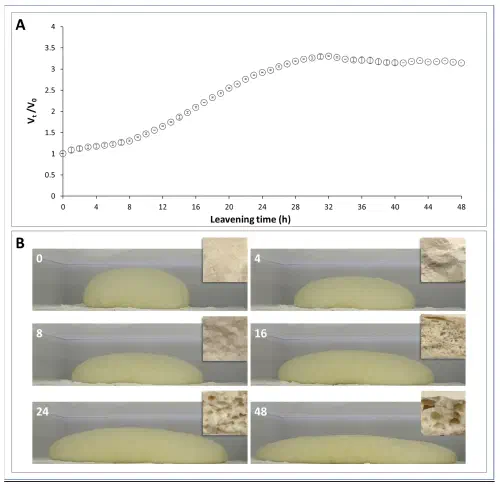
During fermentation, a mechanical transformation occurs known as stress relaxation. Researchers monitoring dough kinetics observed that while dough volume roughly triples over 30 hours, the internal protein matrix undergoes gradual destructuring. Weak interactions between gluten proteins and starch granules begin to loosen up, causing the storage modulus ($G’$) to drop significantly.
Source attribution: Image reproduced from Covino et al., published in MDPI Foods under the Creative Commons CC BY 4.0 license.
By hour 16 through 24, the dough hits a structural sweet spot. Thermal and scanning electron microscopy (SEM) analyses reveal that 16-hour dough exhibits a more open, extensible gluten mesh. This relaxation makes the dough exceptionally cooperative for the pizza maker, allowing the disc to expand easily without tearing while retaining enough structural integrity to trap carbon dioxide microbubbles.
Starch Breakdown and the Precursors of Browning
While the physical structure relaxes, brewer’s yeast (Saccharomyces cerevisiae) and natural flour enzymes are busy conducting chemical demolition. Enzymes like amylase break down damaged starch granules into simpler, reducing sugars such as maltose and glucose. Simultaneously, native proteases slice long protein chains into smaller peptides and free amino acids—most notably asparagine.
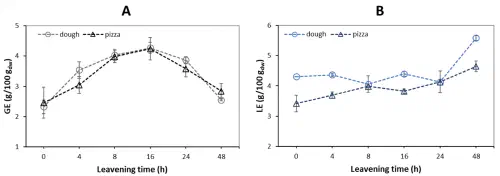
As leavening progresses from 0 to 48 hours, biochemical assays show a steady accumulation of both reducing sugars and free amino groups. In fact, rapidly digestible starch decreases during leavening as hungry yeast cells metabolize the available carbohydrates to produce ethanol and gas bubbles.
Source attribution: Image reproduced from Covino et al., published in MDPI Foods under the Creative Commons CC BY 4.0 license.
Once the dough hits the blistering hearth of a wood oven—where temperatures average 485°C—those accumulated chemical building blocks trigger intense thermal reactions. Heat causes rapid starch gelatinization and drives the famous Maillard reaction, the cascade of amino-sugar interactions responsible for the golden-brown blisters, charred leopard spots, and mouth-watering toasted aromas characteristic of traditional Neapolitan pizza.
The Acrylamide Paradox: High Heat Without the Spike
Here is where food safety chemistry meets culinary tradition. Acrylamide is a well-known processing contaminant and suspected carcinogen that forms naturally in starchy foods cooked at temperatures above 120°C. It develops directly from the Maillard reaction whenever free asparagine reacts with reducing sugars under high heat.
Conventional wisdom suggests a potential hazard: if extended fermentation (up to 48 hours) significantly increases the levels of both reducing sugars and free amino groups in the dough, baking that nutrient-rich matrix at nearly 500°C should theoretically cause an alarming spike in acrylamide formation.
However, the empirical data tells a completely different story. When researchers quantified acrylamide levels in wood oven-baked pizza crusts across every leavening stage—from 0 right up to 48 hours—they found that acrylamide concentrations remained remarkably stable and consistent. Despite having a dramatically higher pool of chemical precursors available at 24 and 48 hours, the final baked pizza bases showed no statistically significant increase in acrylamide compared to short-leavened dough.
Why doesn’t the contaminant spike? The answer lies in the extreme thermodynamics of Neapolitan baking. Because the pizza cooks for only 60 seconds, internal moisture rapid-evaporates and creates a protective steam buffer that regulates crust thermodynamics. While the outermost points of the raised rim (cornice) achieve dark Maillard charring, the ultra-short thermal exposure time prevents the deep, sustained dehydration required for runaway acrylamide synthesis. Furthermore, yeast metabolism during long leavening consumes a portion of the free sugars before they can participate in toxic pathways during baking.
What This Means for Your Next Bake
For casual food scientists and backyard pizza pizzaiolos alike, these findings offer a double dose of validation. You can confidently push your cold ferments or room-temperature leavening out to 24 or even 48 hours to achieve peak dough extensibility, optimal starch digestibility, and incredible aroma without worrying about amplifying heat-induced contaminants.
The science confirms that traditional wood-fired baking is not just a showy cooking method—it is a finely tuned thermal engine where high heat and ultra-short cook times balance flavor development with food safety.
References
- https://pubmed.ncbi.nlm.nih.gov/37048228/
- https://www.mdpi.com/2304-8158/12/7/1407
- https://www.researchgate.net/publication/368645613_Phenomenology_of_Neapolitan_Pizza_Baking_in_a_Traditional_Wood-Fired_Oven